“Wherever You Go, I Will Go”: Queer Readings of the Hebrew Bible
How did texts written thousands of years ago deal with non-normative sexualities? Can we find queerness in the Hebrew Bible and even in the art it inspired? We asked theologian Dr. Karin Hügel.
It’s Pride Month – an opportunity for all of us to open up to queer perspectives in places that we might not even have expected.
As same-sex partnerships gain increasing recognition in some religious communities, a provocative question arises: Did queerness already appear in the Hebrew Bible? And how have complex relationships—such as between Ruth and Naomi or David and Jonathan—been interpreted, painted, and reread across the centuries?
We spoke with theologian Dr. Karin Hügel, an expert in biblical and Jewish studies, art history, and queer studies. She is the author of the German-language book “Studien zu queeren Lesarten der Hebräischen Bibel” (Studies on Queer Readings of the Hebrew Bible), recently published in open access by De Gruyter Brill.
De Gruyter Brill: What prompted you to make queer interpretations of the Hebrew Bible a focus of your research?
Karin Hügel: The Hebrew Bible, with its many different and multi-layered literary texts, presents a rich source for queer readings of today, even more so than the Christian New Testament. On a bleaker note, applying queer studies to biblical studies, Jewish studies, and art history is also unfortunately necessary due to the long and to some extent ongoing homo- and transphobic traditions connected to biblical texts.
DGB: You write about characters such as Ruth and Naomi, or David and Jonathan. What criteria do you use when reading such passages from a queer perspective?
KH: Same-sex couples’ demand for recognition of their life partnerships is now being met, either fully or in part, within various religious communities through wedding ceremonies or blessings. This development led me to interpret certain passages in the Books of Samuel and the Book of Ruth from a queer perspective.
The names of biblical figures such as David (“beloved”), Ruth (“girlfriend”), or Naomi (“sweetheart” or “lustful one”) and their portrayals in a same-sex context suggest queer interpretations of the Bible.
The first encounter between David and Jonathan in 1 Sam 18:1–4 has been used as a scripture reading at actual wedding ceremonies for male couples. In it Jonathan pledges his life partnership to David, “for he loved him as himself.” However, King Saul takes this handsome youth, who has triumphed in battle, home.
Both in the homoerotic narratives concerning the love triangle between Saul, David, and Jonathan (as well as their wives) in the Books of Samuel, and in the polyamorous narrative of Ruth, Naomi, and Boaz in the Book of Ruth, the Hebrew Bible does not feature exclusive partner relationships as is conventional today but rather multiple relationships.
“From a contemporary queer perspective, David’s lament sounds like that of a gay or bisexual man.”
In David’s famous lament for Jonathan in 2 Sam 1:26, he declares that his “brother”—that is, his lover—Jonathan was very pleasant to him, and Jonathan’s love for him was more extraordinary than the love of women. From a contemporary queer perspective, David’s lament sounds like that of a gay or bisexual man.
The use of another reading text, for female couples—Ruth’s vow to be faithful to Naomi, “Wherever You Go, I Will Go,” in Ruth 1:14–17—can be considered too radical to represent contemporary lesbian couples, as it concludes with the words: “only death will separate you and me.” From a queer perspective, Ruth’s affection for Naomi, her mother-in-law, can be interpreted in terms of Audre Lorde’s understanding of eroticism as power: When a woman begins to live from within, in touch with the power of eroticism within herself, she becomes responsible for herself and for others.
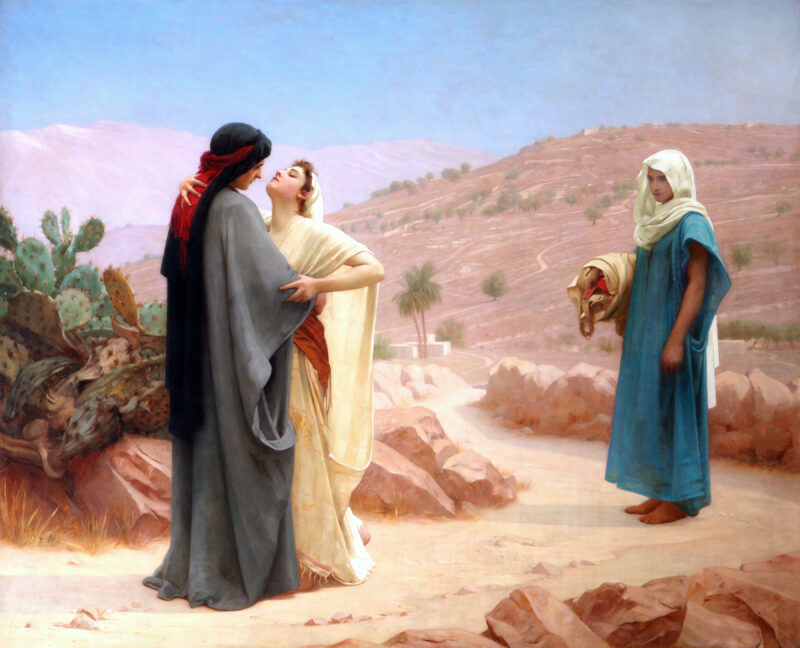
The portrayal of sexually ambivalent figures in works of visual art from the second half of the nineteenth century in England offers queer interpretations of these passages. Simeon Solomon depicts David as Jonathan’s effeminate beloved during their vow of love (1 Sam 20:17), and Philip Hermogenes Calderon paints Naomi as a sexually ambiguous figure in an intimate embrace with Ruth (Ruth 1:14–17).
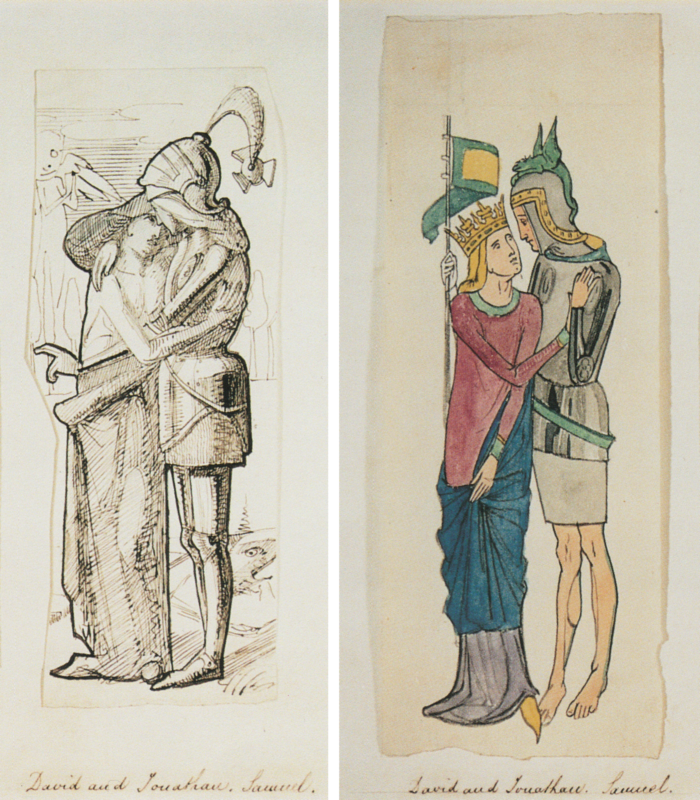
These examples present intertextuality as a preposterous relationship between biblical literature and art. Conventional readers may doubt that such erotic references can be found in biblical passages, while queer interpreters will recognize the homoeroticism in works of visual art in the corresponding texts of the Hebrew Bible.
DGB: Which biblical figures surprised you the most—or gave you new food for thought—whilst you were writing, and why?
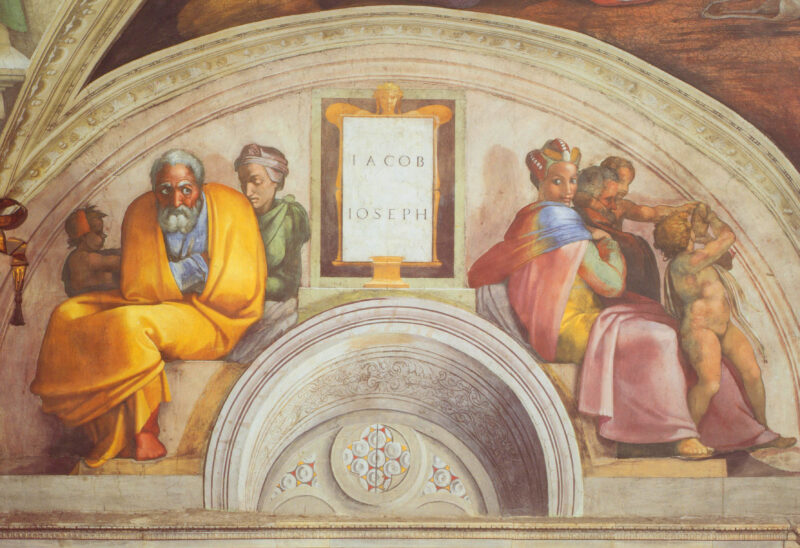
KH: Inspired by a TV documentary on the Sistine Chapel in the Papal Palace in Vatican City, I decided to offer a queer interpretation of Michelangelo’s ceiling fresco depicting Jacob and Joseph. The beautiful, feminine Joseph, son of Rachel and Jacob, can here be seen as a quasi-queer ancestor of Jesus Christ, allowing a queer perspective on the genealogy of Jesus in the Gospel of Matthew 1:16.
“Today, the power of interpretation lies not only with a conventional readership but also with queer readers …”
This interpretation served as a starting point for my queer discussion of homoerotic rabbinic conceptions of Joseph. Joseph, like other biblical figures in the Book of Genesis, was reinterpreted by rabbis in antiquity in several passages of Genesis Rabbah and other religious writings in a rather strange manner with regard to his sexuality. His overwhelming beauty, mentioned in the Hebrew Bible in Gen 39:6, attracts not only women but also men. Joseph’s handsomeness is also emphasized in Islamic tradition, beginning with Sura 12 in the Qur’an.
Today, the power of interpretation lies not only with a conventional readership but also with queer readers, whose interpretations present a challenge and an enrichment based on their own unique experiences and perspectives. Michelangelo’s painting Jacob and Joseph in the Sistine Chapel can thus be regarded as a precursor to a queer appropriation of biblical material.
DGB: Have religious communities reacted to your work? If so, how?
KH: My work on queer interpretations of the Bible since the beginning of the twenty-first century has coincided with a period of rapid socio-political developments regarding queer civil rights, such as the introduction of same-sex marriage.
Over the last years, I have attended numerous conferences and given talks about my research topics, e.g. at the 2nd Congress for the Networking of Christian Lesbian and Gay Groups, Keshet Germany (a Jewish LGBTIQ* organization), or the Colloquium Biblicum Lovaniense. Financial support from, among others, the Gender Studies Association Austria or a fellowship from the Amsterdam Institute for Humanities Research, supported me in continuing my work.
So far, it was not religious associations, but mainly academic societies and the University of Amsterdam, a non-denominational university, that have shown real interest in, and enabled, my queer interpretations of the Hebrew Bible.
DGB: What do you hope readers will see differently after reading your book?
KH: I hope that, in today’s digital age, people will not simply “swipe away” references to my texts on social media or in databases but will actually read them. Studien zu queeren Lesarten der Hebräischen Bibel (Studies on Queer Readings of the Hebrew Bible) is available through open access thanks to funding from the Austrian Science Fund.
My interest in such a subject is unlikely to be shared by the masses. However, I hope that individuals will appreciate my detailed contributions to queer interpretations of Jewish and Christian scriptures as well as works of art and will be inspired to express their own queer thoughts on the matter, whether they “find themselves” in biblical texts or prefer to read them from a historical distance, emphasizing different contexts.
Learn more in this German-language title from De Gruyter Brill

[Title image: Ruth and Naomi, oil on canvas painting by Philip Hermogenes Calderon, 1886; CC BY-SA 4.0]