The Lehrter’s Children: Legacy of a Lost Railway Station
Of all the lost railway stations in Berlin, the Lehrter Bahnhof could be called the least successful from one viewpoint, and the most successful from another. While it seems to have been replaced by Berlin’s Hauptbahnhof, its architectural legacy lives on.
If you build similar buildings, you’re likely get similar results. In the case of Berlin’s Lehrter Bahnhof, the publication of its plans would give the forerunner to the city’s current Hauptbahnhof a legacy that far outlasted the original.
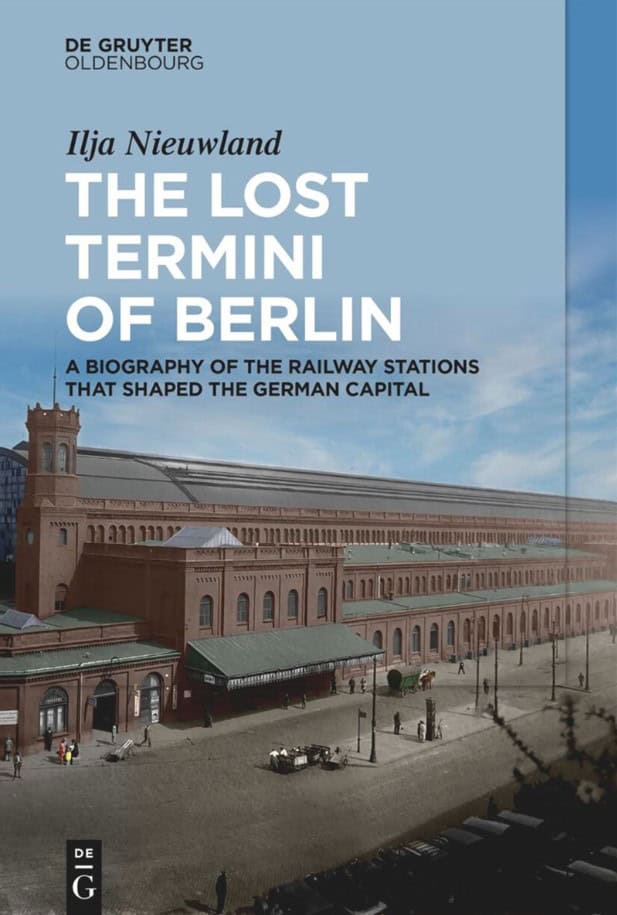
The following is an excerpt from Ilja Nieuwland’s current book, The Lost Termini of Berlin: A Biography of the Railway Stations that Shaped the German Capital.
As unlikely as it may sound, the original Lehrter Bahnhof can still be seen in action – almost.
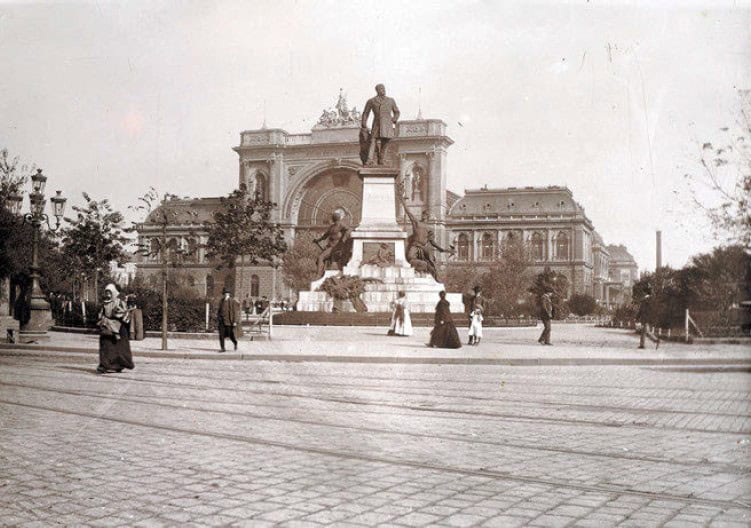
There is a fairly exact facsimile of the building, located in Budapest; called Keleti Pályaudvar (or Eastern Railway Station), it comes very close to being a full-on duplicate of the Lehrter. The building was designed (using some tracing paper and a pencil, one assumes) by the architects Gyula Rochlitz and János Feketeházy and opened in 1884 to serve train lines to Transylvania and the Balkans. This was made easier by the publication of an extensive article about the Lehrter in an architectural journal, the Deutsche Bauzeitung, which included various technical details and drawings, including a ground plan.
“Anyone willing to travel to Budapest can experience something very close to the Lehrter Bahnhof for themselves, even 70 years after it has gone.”
While there are some stylistic differences, these are minor; it has almost the same width (42 vs the standard 37.66 meter Berliner Breite for the Lehrter) and height, the same layout (including, originally, entrance and exit buildings and track layout) and an almost identical façade. It was restored to much of its original splendor during an overhaul of the area in 2004, which means that anyone willing to travel to Budapest can experience something very close to the Lehrter Bahnhof for themselves, even 70 years after it has gone.
While a visitor to Keleti might look upon it as an example of pure plagiarism, it should be remembered that many railway architects habitually took inspiration from examples both home and abroad. Particularly in the early years of the railways, when a consensus on what a station should look like was still up for debate, architects and engineers were on the lookout for well thought-out designs to base their own work on. For instance, the published drawings and situation sketch for Berlin’s Frankfurter Bahnhof (1841) served as model for Amsterdam’s Rhijnspoor station of 1843, while that city’s innovative Willemspoort station (1843) in turn looks suspiciously similar to Paris’s slightly later Gare d’Enfer (today Denfert-Rochereau, 1847).
Station architects clearly habitually kept their eye on previous designs to inspire them. This was not just a matter of aesthetics; technological innovations also needed to incorporated in new structures. An example of such a development are the various ways devised to get trains from one track onto another inside the station. In a terminus, it is important to get the pulling locomotive, which has literally reached the end of the line, out of the way and ready for new use; initially, turntables were used to achieve this. A locomotive would be driven on, then turned around and driven away, but this method had two disadvantages: it took up a lot of space and the diameter of the turntable restricted the length of rolling stock.
 Soon, locomotives started to become too large for the table. The replacement was a shifting table, where a locomotive would drive onto a bit of track on a cart, which would simply be pushed from one track to the next. This still was not ideal, though; it took time and quite a bit of manpower or even dedicated steam power, as locomotives became even more massive. The final innovation was a set of points inside the train shed, which required space also, and combined with the increasing length of trains it required ever-longer sheds.
“Budapest’s station probably crosses the line between inspiration and plagiarism.”
Each of these solutions was essentially hard-wired into the buildings that contained them, and conversion to other ones could be costly and sometimes impossible. For that reason alone, railway engineers and architects needed to keep abreast of recent developments, but they also kept their eye on other designs. As we saw in the case of the second Stettiner Bahnhof, for instance, its design was at least partly influenced by Paris’s Gare de l’Est.
The Lehrter itself was no different; the combination of a central arch with two vertical columnlike elements which made up its façade could be traced back to at least to Braunschweig’s main station of 1848. Although radical solutions were sometimes implemented by choice or necessity, the norm was usually more iterative, building on earlier examples. Even so, Budapest’s station probably crosses the line between inspiration and plagiarism.
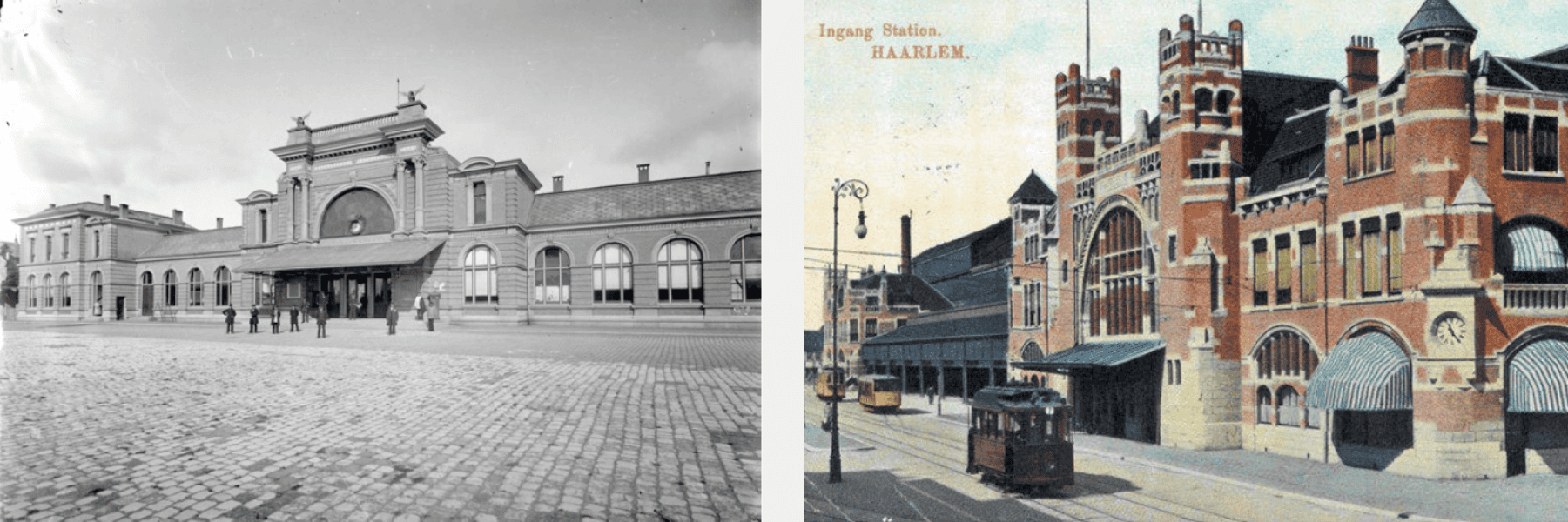
The Lehrter’s influence wasn’t limited to Budapest. In 1879, the university city of Leiden in the Netherlands got its second, much grander railway station; designed by Dirk Margadant, something of a specialist, it took clear cues from the design of the Lehrter. A few decades later, Margadant designed the much better known Haarlem station, which opened in 1908. Still in use today, it is widely considered to be among the Netherlands’ most beautiful stations and an example of art nouveau design in railway architecture. But some of the Lehrter Bahnhof’s DNA returns to Margadant’s work in the form of a monumental entrance, with a large, arched window flanked by two pillar-like structures, with those rounded forms repeated to either side.
The Lehrter Bahnhof itself might not have left the biggest or most favorable impression on its contemporaries in Berlin, but when it comes to spawning an architectural legacy, we may perhaps consider the Lehrter Bahnhof to have been the most successful of them all. And considering what happens on the site today, even the most important.
[Title Image by Credit: IngolfBLN, via Flickr, CC BY-SA 2.0]