The Librarian of the Future: APAC Perspectives Webinar
Librarianship is changing profoundly. Academic librarians curate multimedia collections, manage budgets, negotiate licenses and safeguard research ethics. Some pursue research, others design library spaces with architects. In our most recent webinar, two expert speakers from APAC countries explored the evolving role of the academic librarian.
The Librarian of the Future webinar took place on 22nd October 2026 and was the middle of a series of three interlinked De Gruyter Brill webinars which aim to explore The Future of the Book, the Librarian of the Future from the perspective of two librarians based in APAC countries and the Librarian of the Future from the perspective of two librarians based in European countries. The final webinar of the series will take place on Thursday 10th December. (You can still register here!)
The speakers of the present APAC-focused webinar were Henian E, Library Director at the Eastern Institute of Technology (EITech), Ningbo, China, and Simon Cootes, Manager, Collections and Discovery at the University of Technology, Sydney, Australia. It was moderated by Linda Bennett of Gold Leaf, with technical support by Annika Bennett.
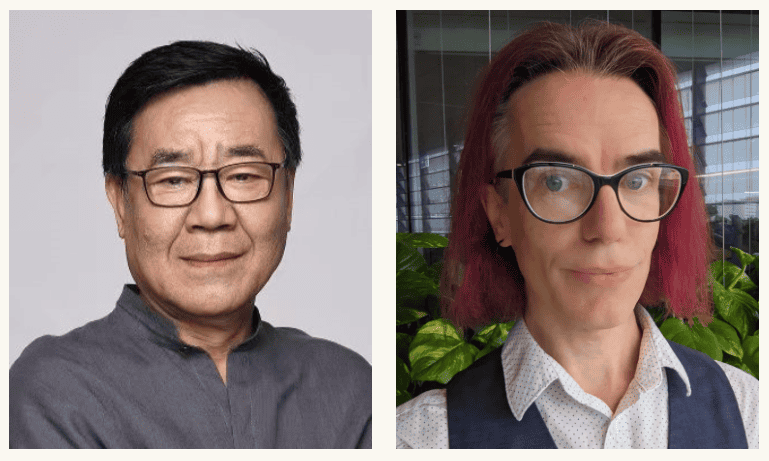
Henian (Henry) E
Henry divided his presentation into two parts: the first to discuss the importance of library design to accommodate the needs of today’s students and researchers; and the second to offer some insights into how librarians, as information specialists and the guardians of university ethics, should address the opportunities and challenges presented by Artificial Intelligence.
Over the past twenty years, Henry has been instrumental in the design of five state-of-the-art libraries in China. When approaching the design of the latest, at EITech, he was able to take into account from the start the likely future balance of the library’s student patrons: 40% undergraduate, 30% master’s and 30% doctoral. He quoted several authors who have influenced the development of the library buildings he has worked on in the twenty-first century, taking as his themes the library as a learning space; as a place for all forms of learning; and the conceptual master plan needed to convince the university’s senate.
“The symbolism of the library at the heart of university life is as important as its functionality.”
He said the symbolism of the library at the heart of university life is as important as its functionality; these two features should be held in balance. The use of precious library space changes over time but must always serve learning activities. It is important to consider what the interior of the library must achieve: accessibility for users; flexibility, to adapt to their learning needs; transparency, to support space management; and mobility, to make it easier to rearrange furniture and facilities.
The librarian must have vision to anticipate what students need even if they don’t themselves have a clear idea. For example, when he was designing the new library at the Southern University of Science and Technology (SUSTech), 90% of the students said they were happy with the old library that the new one was destined to replace; but after the new one had been completed, they were astonished at how much more congenial it was to work in.
Moving on to AI, Henry said that natural-language discovery changes how people find and use information. The librarian’s professional judgement must be central to the successful and ethical use of such information. He quoted a recent report published by Clarivate, which says that librarians in mainland China lead in AI adoption and governance. Concerns about AI adoption include its effect on academic integrity; fear of misinformation; and fear of infringement of privacy and security.
“AI cannot replace human empathy, experience and judgement.”
It is for librarians to develop the skills to address these issues: but they need time in order to do so. Human judgement is vital when setting out on an AI search, as the problem needs to be framed well and the user needs to understand the precise question they wish to ask; and essential when evaluating the outputs that AI produces. AI cannot replace human empathy, experience and judgement.
You are currently viewing a placeholder content from YouTube. To access the actual content, click the button below. Please note that doing so will share data with third-party providers.
Simon Cootes
Simon began their presentation by saying that “predictions can be wildly wrong and highly accurate at the same time”. Over the past twenty years, the emergence of new technologies has often been accompanied by dire forebodings about the future of the library, none of which have materialized. Alongside this, there has been an ongoing debate (also mentioned by Henry) about what constitutes a library. Is it a room with books to study, a website, or people and services? Simon emphasized that libraries are about community; they are places for curiosity, experiment, connection and well-being. They are the anchors of the learning community.
“Libraries are about community; they are places for curiosity, experiment, connection and well-being.”
The foundation principles of libraries have not changed over the centuries: they are guarantors of quality, not quantity: the skills librarians require to find, discern and evaluate information are the same skills required to use AI effectively. It is the context which changes.
Librarians are at the nexus of vast change in the academic sector. They are facing new challenges, while still having the same perennial ones to deal with – e.g., budgetary pressures. But Simon thinks that together Open Access and Artificial Intelligence will change the nature and deployment of budgets profoundly.
The librarians of the future will be internal and external advocates for the community; foster ethical AI development which respects rights holders and creators and scholarly use; and champion everyone, not just lobby groups. The roles in larger libraries will blur; librarians will be regarded as library professionals, not necessarily with the title “librarian”; and library staff may be dispersed to different parts of the university – though Simon cautions against this, because it has the potential to make them less visible and therefore less effective.
The formal presentations were followed by a thoughtful debate which is captured in full in the YouTube recording.
[Title image by supersizer/E+/Getty Images]