“Judicial Dialogues on Health and Climate Change”: An Interview with Alicia Ely Yamin
How can courts respond to the health impacts of climate change? On the occasion of a conference at Harvard Law School on 29 October 2026, sponsored by the Walter de Gruyter Foundation, we spoke with one of its conveners, Alicia Ely Yamin, about the right to health, climate change, and the role of judicial enforcement.
How should international and domestic law respond to the harmful impact of climate change on human health? Who suffers most? And how can researchers inform the next generation of jurisprudence? These are among the questions to be explored in an upcoming conference at Harvard Law School, which brings together judges, litigators, and scholars from Africa, Europe, and Latin America.
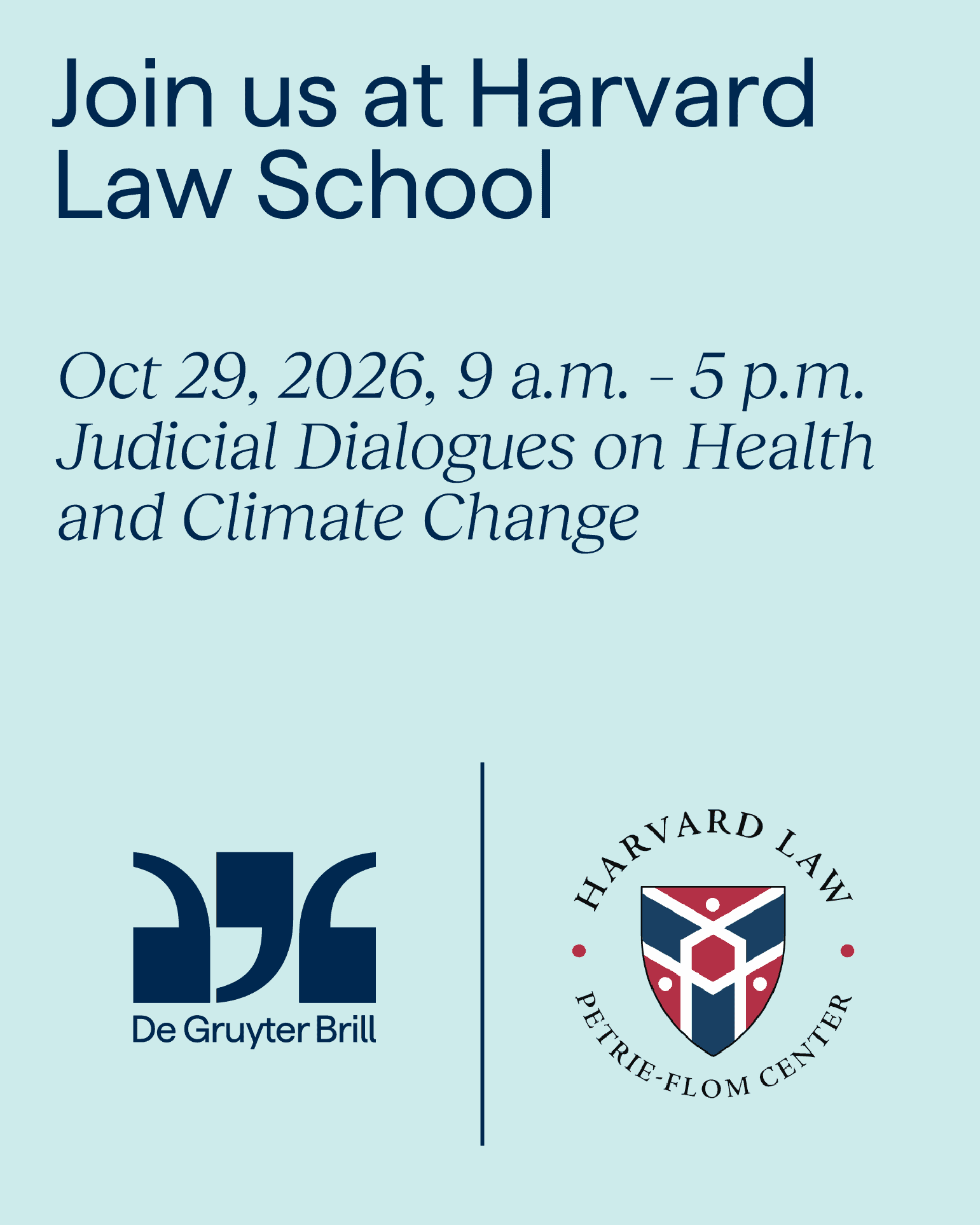
The Walter de Gruyter Foundation is proud to sponsor “Judicial Dialogues on Health and Climate Change: Emerging Standards, Comparative Trajectories, and Future Directions”, taking place on 29 October 2026. Organized by the Petrie-Flom Center for Health Law Policy, Biotechnology, and Bioethics at Harvard Law School, the event is open to the public and will be live-streamed.
As I. Glenn Cohen, Director of the Petrie-Flom Center, explains: “There is no more pressing long-term issue for health than the effects of climate change. We are lucky to be joined by international judges that have led the way in exploring the legal terrain and scope of rights claims in this space. The Petrie-Flom Center is honored to host this important conference and help bring Professor Alicia Ely Yamin’s vision for the discussion to a reality.”
Ahead of the event, we spoke with Alicia Ely Yamin, Senior Fellow at the Petrie-Flom Center and Director of its Global Health and Rights Project, who is one of the conference’s conveners alongside I. Glenn Cohen. Alicia is also editor of the Brill | Nijhoff series Global Health, Human Rights and Social Justice. In this interview, conducted by Lauren Danahy, Acquisitions Editor for International Law at De Gruyter Brill, she discusses her own path in global health and human rights and the purpose of the event.
Lauren Danahy: Thank you for taking the time to join us to talk about this interesting event and the broader topic of climate change, the right to health and judicial enforcement. Before we get into the event, can you tell us about how you came to be interested in global health and human rights?
Alicia Ely Yamin: Sure. First of all, thank you so much for doing this conversation. And also thanks to the De Gruyter Foundation for supporting the event, the “Judicial Dialogues on Health and Climate Change,” which I think is going to be a really interesting and timely event that brings a lot of people together.
I am a human rights lawyer by training, and I focused on economic and social rights because my aspiration always was to use human rights to advance social justice. After graduating from Harvard Law School, I had a fellowship in Mexico for a couple of years and did traditional human rights work. I brought litigation against the federal judicial police for arbitrary detentions, extrajudicial executions, torture and things like that. But I also spent a lot of time in Indigenous communities there and saw how health is such an acute reflection of patterns of injustice and inequalities, and I decided then to focus on health in terms of economic and social rights.
“We’ve seen a lot of progress, although of course now there are also threats to that progress.”
It’s been a circuitous journey because I went to a Wall Street law firm and paid off debts, but I later got a Master of Public Health and have focused on building out what is the right to health. When I started that, nobody was talking about a right to health. It was just considered to be a policy aspiration. Now we have close to 160 countries in the world that are enforcing one aspect or another of health rights. Through the right to life and through equality jurisprudence, international law has evolved a huge amount since then. We’ve seen a lot of progress, although of course now there are also threats to that progress.
LD: What kind of role, as you see it, should international courts play in establishing and/or enforcing law and policy where climate change and its impacts on health and human rights intersect?
AEY: This event is happening at a time when the International Court of Justice [ICJ], the Inter-American Court of Human Rights and the Tribunal for the Law of the Sea have issued important advisory opinions. And those advisory opinions don’t relate to enforcing obligations in specific cases. The ICJ opinion sets up a framework to think about state obligations with respect to climate change. The Inter-American Court opinion is much more focused on human rights per se. But they are extremely important in setting frameworks or parameters for what courts at the national level can do and what public policies should consider in these countries. And they feed one another.
Register your attendance – whether in person or online – to the conference here!
The whole purpose of this event, which is called “Judicial Dialogues,” is to create a dialogue among these supranational tribunals, but also a dialogue between the ICJ and the Inter-American Court and the constitutional and apex courts at the national level that are seeing the concrete effects of climate change on health. Also, [its purpose is] to have a dialogue with the litigators that are bringing these cases and the scholars that are understanding what they are about, developing evidence, etc.
LD: The event is divided into panels of judges from international and domestic courts, academic researchers, and advocates and litigators. What was your thinking in designing it this way?
AEY: The word and the framing of “dialogues” is not accidental because we want these different actors to be speaking to one another. I think the opportunities for learning are really extraordinary under those circumstances. It’s amazing that we’ve been able to bring together judges from supranational forums, but also judges from different regions around the world who are dealing with these issues and thinking about them with possibly different legal toolkits and different national contexts.
“The word and the framing of ‘dialogues’ is not accidental because we really want these different actors to be speaking to one another.”
We’re hoping that this will be a fruitful set of conversations. I think for students — because they are a big audience for this — it’s helpful to understand the role of international courts, the separate, distinct role of national courts, and to hear what advocates and scholars are thinking about and how they assess these different judgments, which is invariably different from how judges think about their own roles.
LD: In your view, what are the major challenges to advancing policy and protections in this space, and how do you remain hopeful when we see states not living up to commitments, such as those in the 1992 United Nations Framework Convention on Climate Change (UNFCCC) or the 2015 Paris Agreement?
AEY: On the one hand, imagine the world without the Paris climate agreement, right? That did set up aspirations. It did set up a framework for thinking about this. We have made progress — more progress on commitments than on implementation — but we have made progress in terms of turning away from fossil fuels toward clean energy in different capacities. It’s certainly not enough, right? We’re behind, and we’re going to exceed 1.5 degrees [Celsius]. But the worst, most catastrophic predictions have been adjusted downward. So, that gives me hope. It gives me hope that so many social movements, especially youth-based social movements, are working in this area. The ICJ advisory opinion was spearheaded by students from Vanuatu, and that, I think, is incredibly promising. I think during the event we will see and hear about promising technological innovations to track the effects of heat, for example, on informal workers and to measure those effects on health indicators. That gives me hope.
“It gives me hope that so many social movements, especially youth-based social movements, are working in this area.”
The greatest challenge in the immediate term may be the geopolitical context and the fact that the United States government now has not only backed away from its own commitments but is literally stymieing progress in this area. That has an enormous impact around the world and gives permission for other governments to back away.
I think in the longer term and from a more structural view, the question is one of political economy and how very powerful actors — whether it’s the fossil fuel companies or the tech giants that use a lot of energy and data centers, etc. — can be effectively controlled and incentivized, because they have such an enormous economic concentration of power and, in turn, political concentration of power. And of course, it’s very challenging for courts to catalyze political organs of government to make effective public policies to rein in that private power.
LD: Is there a question that I didn’t ask that you wish I had?
AEY: I don’t think so. I’m very excited about this event, and I think the degree of enthusiasm from scholars and activists as well as from all of these different judges from around the world speaks to the need to have these conversations and dialogues at this time. This is one of the most existential challenges of our time and brings in so many different intersectoral questions. I’m very pleased and humbled that we’ve had such a reaction, and I’m hoping the event can contribute to future conversations.
[Title Image by Max Zolotukhin/iStock/Getty Images Plus]