Building The Airplane While Taking Control and Flying It: Academic Libraries and AI
Our recent survey of librarians identifies patterns of AI adoption at a pivotal moment, highlighting both widespread recognition and clear divisions over ethics, costs, and control. The researchers shared and explored these insights in our latest webinar.
Click here to catch-up with De Gruyter Brill and Gold Leaf’s quarterly webinar series.
The first De Gruyter Brill webinar for librarians to take place in 2026 was also our most successful webinar yet, attracting just short of 800 registrants worldwide. The webinar was unusual in two respects: it was presented by Annika Bennett and Linda Bennett of Gold Leaf, instead of being moderated by them (Gold Leaf carried out the research for De Gruyter Brill on which the presentation was based); and it was chaired by Billy Sawyers, owing to the unexpected absence of regular DGB sponsors Andrea Gregor-Adams and Deirdre Watchorn.
You are currently viewing a placeholder content from YouTube. To access the actual content, click the button below. Please note that doing so will share data with third-party providers.
The foundation study was ambitious: it sought to capture the insights and observations about AI is being addressed and deployed at their respective institutions. It was also designed to test a hypothesis developed by Dominique de Roo, Chief Strategy Officer at De Gruyter Brill, that attitudes to AI in academia vary across the world’s major geographical regions.
The main vehicle used for the research was a SurveyMonkey survey, supplemented by 12 in-depth interviews conducted with librarians based in these regions. The survey attracted 311 responses from all the main geographical regions (though response rates from South America and Africa were low). The respondents were extremely generous with their time and put considerable effort into answering the qualitative questions, thus providing a rich and complex picture. It is only possible to record a few of the key findings in this post: the webinar itself provides much extra detail.
“Perhaps the biggest surprise was that Canadian librarians were almost uniformly hostile – some expressing themselves with great vitriol – about AI.”
Globally, 89.8% of respondents said that use of AI – in any form – was recognised as a legitimate tool at their institution / library. Regionally – but from a small response pool – Africa was the only region to show a 100% positive response, followed by the USA (94.9%). However, recognition does not imply approval, and replies to subsequent questions showed that librarians have considerable misgivings about exactly how institutions should allow AI to be used.
Regional differences were indeed marked. Perhaps the biggest surprise was that Canadian librarians were almost uniformly hostile – some expressing themselves with great vitriol – about AI, whereas their American counterparts divided into 3 camps, those who supported AI wholeheartedly, those who embraced it cautiously, with caveats, and those who felt dismayed and overwhelmed by the implications it brings. Respondents from the UK and Ireland were also cautious and could see many pitfalls, as well as some benefits. Respondents from Europe showed concern, but little animosity; and respondents from India and the APAC countries generally took a more pragmatic view, appreciating that AI could assist in the more rapid completion of many repetitive tasks. The Chinese respondents were particularly enthusiastic, and undoubtedly saw AI as one of the means of helping their institutions to get ahead.
Globally, 47% of respondents said their institution or library had developed guidelines on the use of AI; 35.6% said they were working on it. The remainder mostly said that their existing policies on plagiarism and ethics adequately cover use of AI. Globally, 65.3% said the library offered workshops on AI; 34.7% said it did not.
“The Chinese respondents were particularly enthusiastic, and undoubtedly saw AI as one of the means of helping their institutions to get ahead.”
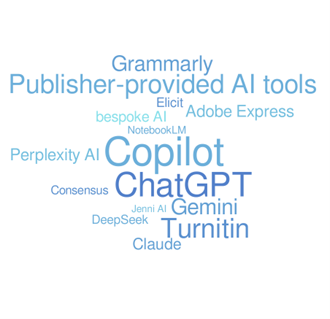
Copilot was the most popular AI tool listed by respondents, with ChatGPT coming a close second, followed by Turnitin and publisher-provided AI tools. The popularity of Copilot (a Microsoft tool) was attributed in part to the fact that many universities already have site-wide Microsoft licences, partly because Copilot offers a guarantee to ring-fence patrons’ data (though some respondents voiced scepticism about the efficacy of this). One US respondent said, “Copilot offers us Enterprise Data Protection and has more accurate results than any other chatbots.” Copilot is available in both “free” and paid-for versions, and was the only AI application mentioned for which more respondents were paying than not paying.
Asked what kinds of AI tool respondents might be prepared to pay for in future, most respondents exhibited a strong resistance to paying extra for AI “add-ons”. There was therefore a low appetite for per-user fees and product-level AI surcharges; slightly more enthusiasm was shown for (modest) institutional subscriptions and one-off purchases. It is worth pointing out that one unintended consequence of the development of AI in academia is that many institutions in the “economic south” are unable to pay for any AI products and will therefore be shut out of the opportunities that all but the basic AI tools may offer their students and researchers.
The survey sought to discover if librarians’ attitudes to AI were more conservative than those of academics and university administrators, and found that this was often the case. However, there was still a very mixed overall response, especially from respondents based in the USA. Here are a few quotes:
- “Weariness mixed with resignation.” [USA, Public HEI]
- “AI is a useful tool that needs to be leveraged.” [USA, Private HEI]
- “Excitement.” [USA, Private HEI]
- “ Some love it, some recognize that it is here and we need to find a way to teach with it and in spite of it, some hate it. It is becoming problematic in ensuring academic honesty especially with remote/online classes thus some are going back to blue book in class writing, some online classes now have required in person proctored exams, etc.” [USA, Community College]
The Q&A session was lively. Participants asked about the effect of AI on the environment, its effect on the future roles and responsibilities of librarians and dug further into the question of policies, checks and balances, as well as what librarians might or might not be willing to pay for in the future.
The way that AI is used in academia is changing fast: the study offers a snapshot of the stages reached across the world in late 2025. The following conclusions may be drawn – and some will still be relevant in the longer term, as the capacity of AI evolved further:
The study strongly supports the hypothesis that use of and attitude to AI differs in different geographical regions; even the most enthusiastic AI supporters recognise that clear ethical guidelines should be established by the library / institution; training in correct / optimal use of AI is key; the most favoured AI applications are those that work across a variety of disciplines, product wrappers and suppliers; and it is early days yet!
The full recording of the webinar may be found here: https://youtu.be/3-PmeBRixhI
You might also be interested in this blog series

[Title image by ruiruito/iStock/Getty Images]