APE Conference 2026: Scholarly Communication at a Turning Point (Day 2)
What challenges does the post-truth era present for scientists and publishers? How do we navigate the slippery slope of AI? And how can we keep the humanities visible in scholarly publishing? Discover the key insights and highlights from day two of the APE Conference.
Today’s post offers highlights from Day 2 of the APE Conference (Academic Publishing in Europe), held at the European School of Management and Technology Berlin (ESMT). Our post on Day 1 may be found here.

Research Integrity in a Post-Truth Era – New Challenges, New Tools
Day 2 of the APE Conference began with “Research Integrity in a Post-Truth Era – New Challenges, New Tools”. It was moderated by Sami Benchekroun of Morressier / Molecular Connections Group. The panellists were Anna Abalkina, Freie Universität Berlin; Miriam Maus, IOP Publishing and Sonja Ochsenfeld-Repp, Deutsche Forschungsgemeinschaft (DFG). The session immediately picked up on the previous day’s central theme of maintaining research integrity in a world threatened by “bad science” and fake research.
Anna Abalkina said that the majority of traction by the major publishers in 2025 was in fact “massive retractions”. Publishers were gaining a greater understanding of what it means to publish “clean literature” and now know much more about fraudulent signs in specific disciplines – e.g., cancer research.
Sonja Ochsenfeld-Repp, a lawyer responsible for maintaining sustainability in research practices, welcomed that there was new dialogue between funders and publishers.
Miriam Maus said she was responsible for content at IOP and maintaining its integrity was her “number one” task. Paper mills are now becoming more sophisticated and citation manipulation is quite hard to catch. The challenge is to identify the problem early in the process. As Caroline Sutton said on the first day of the conference, trust in information is at an all-time low and it is the publisher’s responsibility to foster trust in science(s).
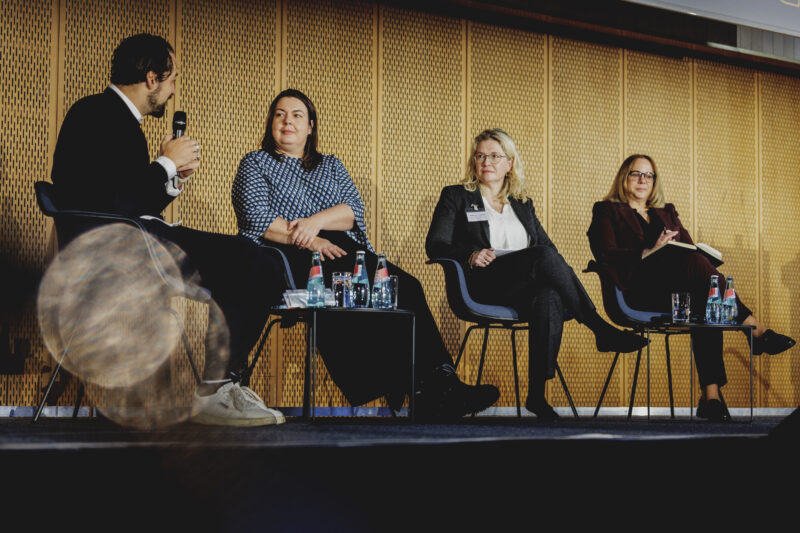
Sami asked whether, from a systems perspective, publishers were doing “more of the same”, or something different. Miriam said that IOP has changed how it deals with submissions. “There is much more realisation that trust in individuals is not a protection and we need to trust in processes instead.” However, she did not yet envisage radical change in the outputs of publishing: “Demand from the research community to publish traditional articles is still there.”
Sonja said that peer review is one of the main trust signs for funders. In 1998 a white paper was published on safeguarding good practice in publishing and its tenets are still relevant. Funders are trying to change the perception that quantity – a mass of publications – trumps the quality that can be achieved by publishing less, when the reverse is true.
Sami asked Anna who was the villain in all of this. Anna said it was her mission to disrupt the business model of the paper mills, but that so far this was not working. Only a tiny number of published articles are retracted, and then often only after a very long time. There are structural problems to address, particularly the conflict between profit and research integrity. “We are all the villains.”
The panel concluded that metrics need to be more sophisticated and reflective; that publishers should retract more articles; and that there is a significant role for institutions to play, particularly by engaging in raw data archiving and pre-submission screening.
Uncharted Intelligence: AI, Policy and the Global Reinvention of Scholarly Publishing
This session was moderated by Jude Perera, Associate Director, Communication & Engagement, at Wiley. The panellists were Richard Gallagher, President & Editor-in-Chief, Annual Reviews; Lukas Pollmann, Lead Customer Engineer for publishers at Google Cloud, Germany); and Sahar Vahdati, Professor of AI for Science, Leibniz University of Hannover.
Jude asked Richard how editors can tell when a journal contains AI-generated content. Richard said that a good article is not just a coherent organisation of facts. AI can scan huge bodies of literature in different styes, connect ideas across disciplines and make studies of massive, complex data sets, but it is not human, so its outputs do not include the human effects on research. It helps by leaving the researcher free to apply the element of human understanding. “Science is a very creative, very human process. We want to capture the incredible ability of AI to bring material together and add the human dimension.”
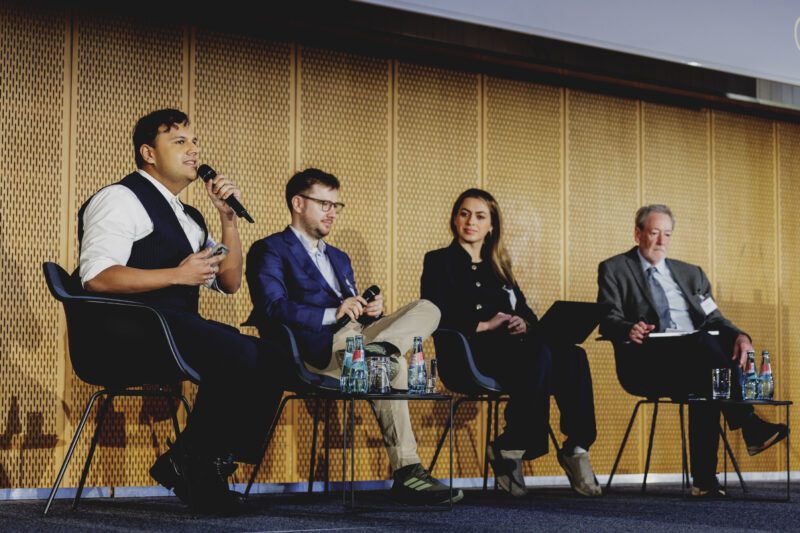
Sahar said that the AI models that we see at the moment can only perform about 3% of the synthesis and analysis that humans do – humans operate at 85% – 90% levels. “We need an ecosystem that is supported by AI, but so far these models have been created from what humans have created. In future we need to control by using AI not to make decisions, but to support decisions.”
Lukas said that AI can be a positive force for good – it can enable greater use of resources than would otherwise be possible and has the potential for uncovering nuggets that researchers otherwise may or may not stumble across. But it can be the beginning of a slippery slope: “What happens if AI actually takes over our thought processes?”
Sahar concluded the debate by saying that collectively we need to work on creating machine readable information that can be judged by humans – to think of a new model and come together in a new way.
Keeping the Humanities Visible in Scholarly Publishing
The session was moderated by Ove Kähler, CEO of Mohr Siebeck. The panellists were Barbara Budrich, Founder and MD, Verlag Barbara Budrich; Professor Dr Thed van Leeuwen, Professor of Monitoring Open Science Policies and Practices, Leiden University; and Christoph Markschies, President, Berlin-Brandenburg Academy of Sciences and Humanities.
Professor van Leeuwen began by saying that peer review is always the main driver for the assessment of research. Different disciplines demand different approaches to research: for historians, working in the field is not common; conversely, epidemiologists can only work in the field. STM knowledge reaches its peak citation rate 3 – 4 years after publication and then declines; research in AHSS, on the contrary, can suddenly achieve spikes in citation decades afterwards.
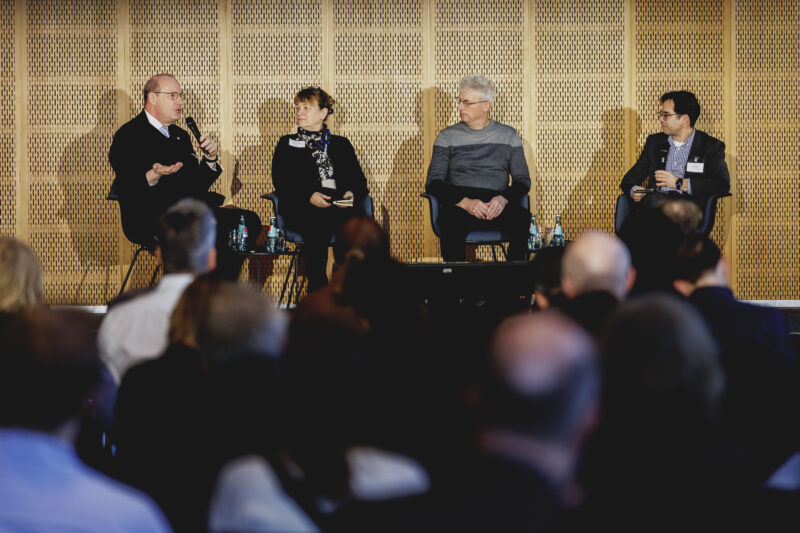
Christoph Markschies said that publishers “should not jump too early to assume that the Tik Tok generation are not interested in monographs”. For an author, the difference between the serious publisher and others derives from the personal context. “All my publishers are interested not just in the next book, but in the publication process that benefits the discipline – what we need is an Oxford handbook of handbooks.” In detecting AI-generated content, it is necessary not only to train technique, but also the ability to judge – to be competent to ask, “is this a valuable manuscript with human-produced judgement?”
Barbara Budrich said that she did not recognise the distinction usually made between STEM and non-STEM subjects. All are sciences! One of the things that publishers bring to every discipline is good English – “English is our tool”. It is the publisher’s role to remove disciplinary jargon from publications. Publishers also try to influence critical thinking – and in publishing, trial without innovation won’t work. She also emphasised the professionalism that publishers bring to publishing, with the many years of experience they have behind them. Libraries wishing to turn publisher may think it looks easy, but “you don’t see what we do.” Publishers curate, they discuss, they know the disciplines in which they operate in a way that no scholar does – if librarians want to take this on, they can, but they must train for it.
Startups to watch – Innovators of tomorrow
The afternoon of the second day kicked off with a Dragons’ Den-type assessment of three new solutions that are being developed to assist scholarly publishers. The audience-elected winner (of three entrants) was Pure.Science, a start-up application designed to transform scholarly workflows.
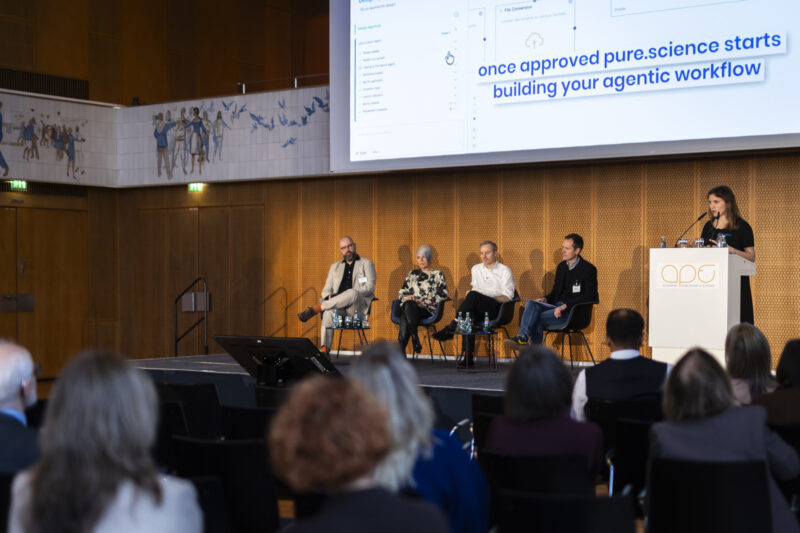
This was followed by a presentation of the findings of a pre-conference workshop that sought to identify the gaps between current and desired AI usage in publishing.
Science Publishing in Crisis: Challenges and Solutions
Ed Pentz, Executive Director, Crossref moderated this session. Panellists were Steven Inchcoombe, President of Research, Springer Nature, UK; Dan Larhammar, Member & former President of the Royal Swedish Academy of Sciences; and Professor Bernhard Sabel of the University of Magdeburg & Sciii gGmbH, Berlin.
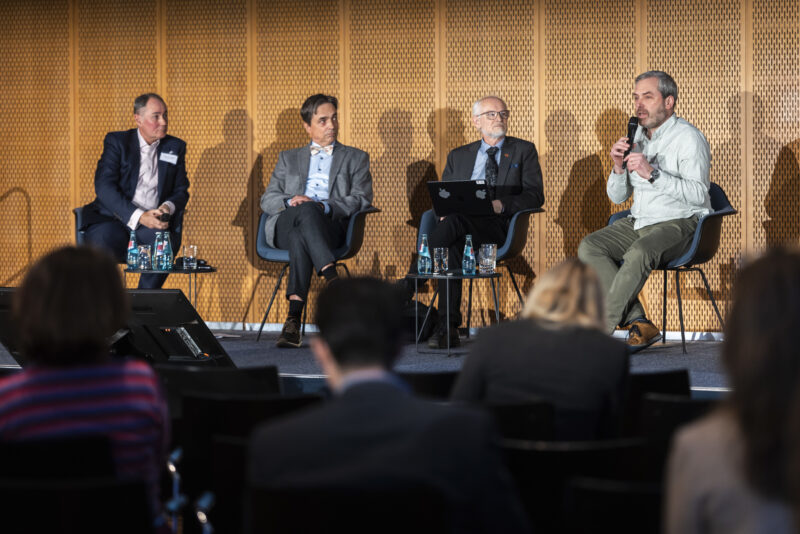
Dan Larhammar and Professor Sabel presented the Stockholm Declarations on the maintenance of integrity and quality control in the dissemination of scholarly research. They said that funders should take a more active role – “they have to realise that they are wasting money on fake science.”
Steven Inchcoombe responded from the publishers’ perspective, saying that publishers will “have to foot the bill” to make the publication of scholarly publishing more secure if they wish to retain the trust on which their organisations depend.
The conference concluded with heartfelt thanks from Ingo Rother, MD of the Berlin Institute for Scholarly Publishing. Ingo’s second APE Conference was well-received, combining informality and light-heartedness with seriousness of purpose and a choice of topics that appealed to a wide range of participants in the scholarly publishing community.
[Title image by Photothek]