The Bayeux Tapestry: What Can We Read Between the Stitches?
Almost a thousand years ago, one of the most famous pieces of textile art was stitched together in Medieval England. We talked to historian Gale R. Owen-Crocker about the secret language behind the Bayeux Tapestry—and her ongoing quest to find new clues.
While for some it might be hard to believe, one of the most eagerly awaited visitors to London this September is … a nearly 1,000-year-old embroidered cloth. Tickets to see the Bayeux Tapestry in the British Museum were sold out in record time, with hotels even offering a pricey “Bayeux experience.” It’s not just medieval art buffs going crazy about this historic loan from France.
But back to the beginnings.
Most likely, the Bayeux Tapestry was ordered in the 1070s by Bishop Odo of Bayeux to portray the events that preceded the Norman Conquest of England. Despite many speculations and theories, its designer(s) remains unknown.
In 1476, the Tapestry was first described in an inventory of the treasures of Bayeux Cathedral in Normandy. In the centuries after, it experienced several relocations, often during major historical events unfolding around it. During the Franco-Prussian War, in 1792, the Tapestry – 70 meters long and 50 cm tall – was used to cover a military wagon. It was rescued and replaced with a stout piece of canvas. Centuries later, in 1944, at the urging of Heinrich Himmler, the Tapestry was taken to the Louvre in Paris – almost certainly with the intention of taking it to Germany. However, Paris fell to the Allies before this could happen, and in 1945, the Tapestry was returned to Bayeux. From September 2026 to July 2027, its temporary home will be the British capital.
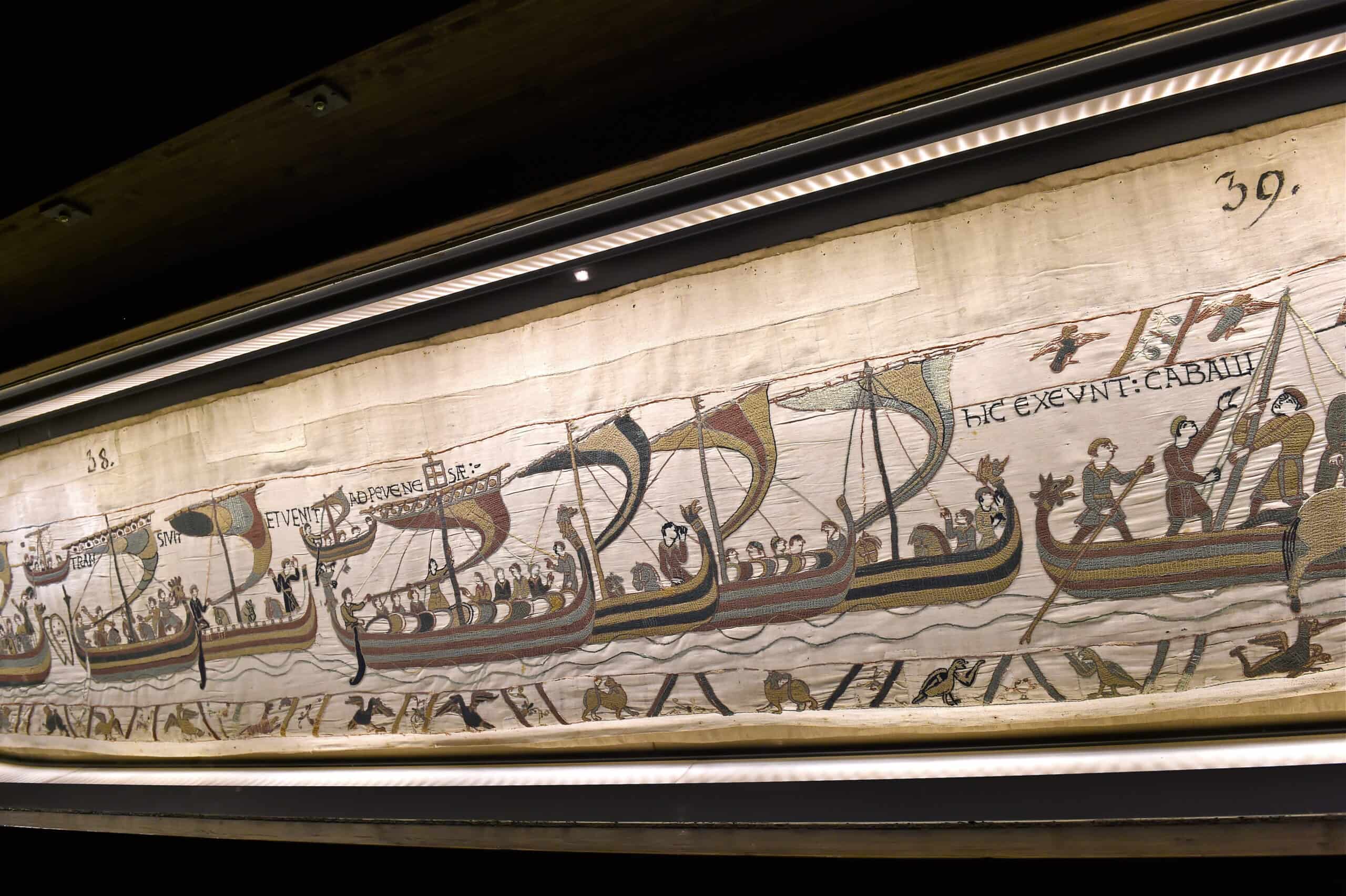
What makes the Bayeux Tapestry so fascinating—even more than nine centuries after its creation? In her new book The Design of the Bayeux Tapestry, Gale R. Owen-Crocker demonstrates that it’s still possible to uncover new secrets in this timeless medieval masterpiece—even a secret language.
Professor Emerita at the University of Manchester (UK), Gale R. Owen-Crocker was formerly Professor of Anglo-Saxon Culture and Director of the Manchester Centre for Anglo-Saxon Studies. We hope you enjoy the following conversation with her.
De Gruyter Brill: For readers who may be unfamiliar with it, what exactly is the Bayeux Tapestry, and what story does it tell?
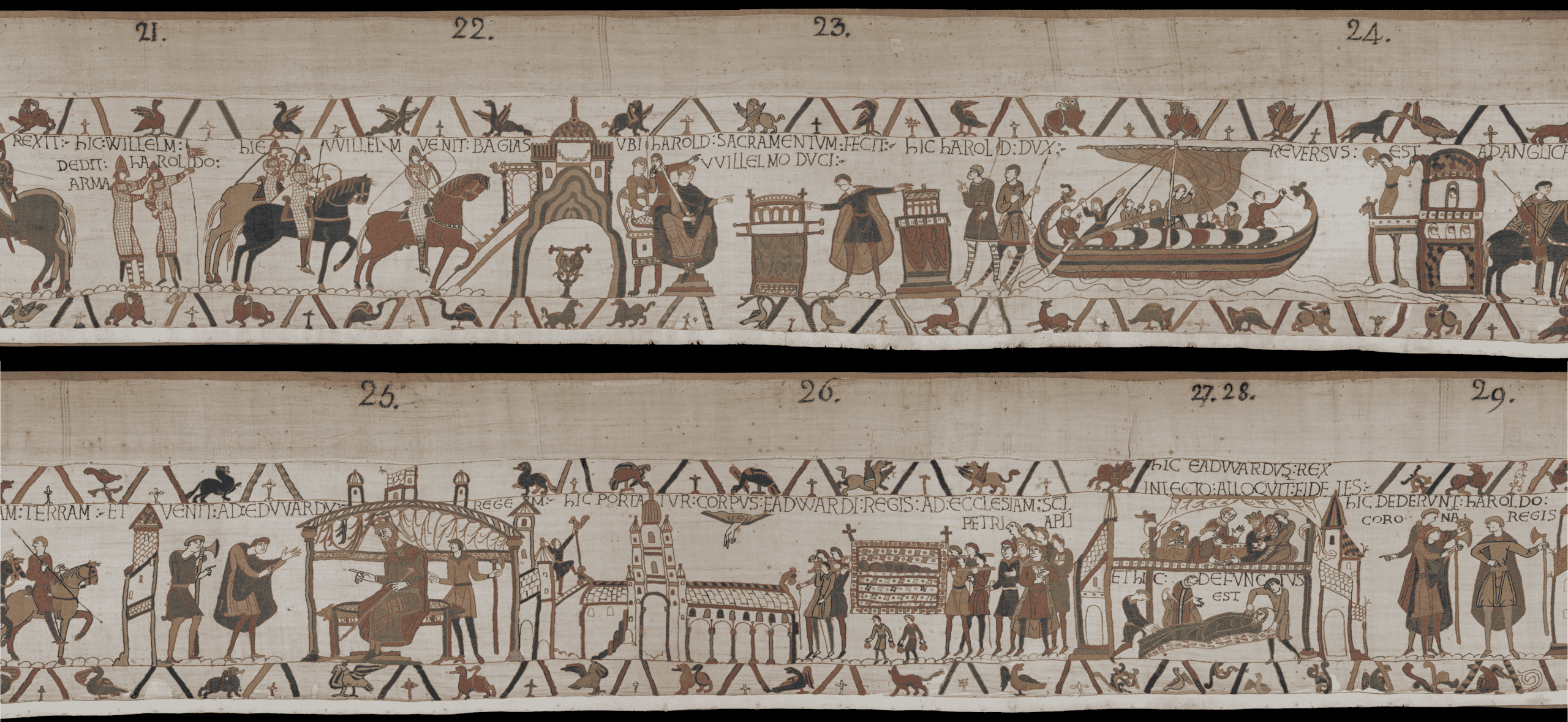
Gale R. Owen-Crocker: It is an embroidered narrative frieze, a wall hanging. In 58 scenes, it depicts events (allegedly) leading up to the Norman invasion of England, culminating in the Battle of Hastings on 14 October 1066.
Harold Godwinson, King Edward’s brother-in-law and effectively the governor of England, goes on a journey on horseback, then by ship. He is arrested in Ponthieu, northern France, but released into the custody of Duke William of Normandy. They campaign in Brittany together and William rewards Harold with arms but extracts an oath from him. Harold then returns to England and later succeeds King Edward after the latter dies. When the Normans learn this, they prepare a fleet and cross the Channel, pillaging southern England and building fortifications. The two sides come together in a battle with slaughter on both sides, but Harold’s brothers and then Harold himself are killed. The English appear to be fleeing as the embroidery breaks off.
DGB: What first drew you into this subject?
GOC: My doctoral research on Anglo-Saxon dress. Later, research on early textiles made me aware of the Tapestry’s uniqueness as a survival. It’s the largest surviving textile from the Middle Ages, in fact the largest non-architectural artefact from the period.
As a University English teacher specializing in Old English poetry, I came to recognize that the Bayeux Tapestry used many of the narrative devices that I found in literature: for example, reducing the characters and events to make a good story, in this case of two proud, brave men, rivals for the throne; ring structures; anticipation and echo; and recurring formulas.
“I can’t look at it without seeing something new!”
This involved looking very closely at the Tapestry. I seemed to see details previously unnoticed, including how images were arranged, the body language and gestures of the characters, and amusing/significant/surprising details of the animals in the borders. I can’t look at it without seeing something new!
DGB: At what point did the idea for a book take shape?
GOC: At least 30 years ago, but I couldn’t see, then, how any publisher would illustrate it the way I wanted, with numerous color plates and a color facsimile. Meanwhile, my ideas evolved. I wrote academic papers on the Tapestry, collecting 15 into a published volume in 2012. I was also involved in conferences that featured the Tapestry, editing and co-editing the proceedings of three.
Also, I gave many lectures on the Tapestry, benefitting from discussions and questions. My inspirational graduate students at Manchester University included the late Patricia Cooper, former draftsman and award-winning cake decorator, who recognized geometric grids in Anglo-Saxon illuminations, and who first showed me that some Bayeux Tapestry images were squares. Then there was Maggie Kneen, professional artist and archaeological illustrator, later my collaborator on an essay on templates and the artist I needed for my book. I cannot over-emphasize her skill and patience. There have been several more who have since published on the Bayeux Tapestry, and others whose ideas I acknowledge in the book.
DGB: Were there particular challenges in working with fragmented, multilingual, or ambiguous source material?
GOC: Definitely. A cross-disciplinary approach was necessary because medieval manuscript art, Roman sculpture, documentary history, textile history, language, literature, and mathematics are all different academic fields (and math is definitely not mine!).
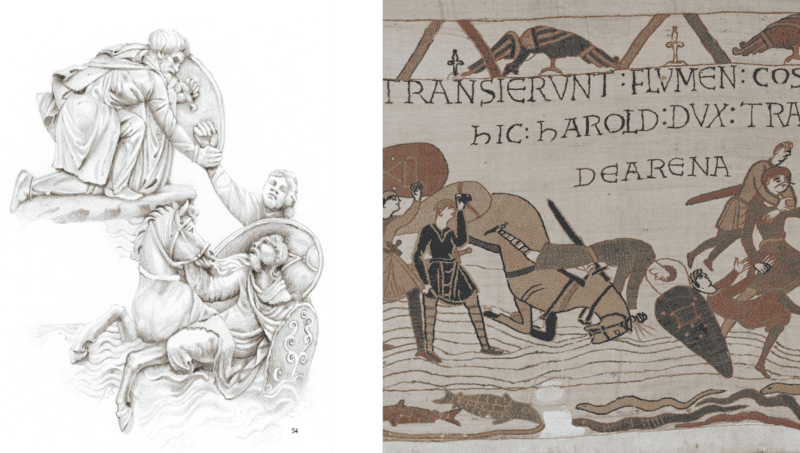
All book-form facsimiles of the Tapestry cut through scenes because of their page divisions. This made the relatively large, printed versions of the Tapestry—though beautiful (especially David M. Wilson’s)—frustrating to work with. Only a one-seventh size pull-out version really conveyed the Tapestry’s continuity. However, quite late in the writing process, the Bayeux museum kindly allowed me access to their digitized continuous version (SIDS). It includes a reversed version of the back of the Tapestry, which is essential for recognizing modern repairs.
Digitized versions of crucial manuscripts appeared recently, and are a wonderful resource, saving travel costs for personal examination of fragile materials, though the hacking and subsequent withdrawal of the British Library’s collection in 2023 caused me anguish!
DGB: What was the most surprising thing you learned while researching this work?
GOC: Among my unique personal approaches was the conviction that I should read the text related to the images the designer borrowed from manuscripts that still survive. The results were astonishing in relation to the Norman brothers, William, Odo and Rotbert. The designer consistently borrowed images of biblical tyrants and sinners, and I felt I could read the mind of the designer by following up these images. Although the Tapestry ostensibly told the story from a Norman point of view, with Harold reneging on an oath made to William and so committing perjury, it seemed the designer was bitterly hostile to the Norman conquerors.
“Although the Tapestry ostensibly told the story from a Norman point of view … it seemed the designer was bitterly hostile to the Norman conquerors. ”
An entirely different discovery came from experiments to see if the Tapestry’s images were consistently composed as squares. I found that there was regular use of squares and rectangles mathematically derived from them (aurons and diagons) and that the whole tapestry could be described in these terms.
DGB: How is the Bayeux Tapestry—900 years after its creation—still relevant today?
GOC: As a historical document it gives evidence of the events leading up to the Norman Conquest, some of which differs from other written sources. This Conquest changed England not just in terms of its royal line but also in terms of land holdings, the people in charge of the Church, and the language of the ruling classes.
As an artwork, it is a unique example of the kind of colorful wall hangings that—albeit on a much smaller scale—probably decorated many eleventh-century homes. As a text, though basically written in Latin, it is a demonstration of that mixture of languages which came to proliferate in texts written in the centuries following the Conquest (French/English/Latin).
Above all, though, it is so lively! It presents active, busy figures talking, riding, fighting, swearing an oath, arguing … They are people, just like us.
DGB: What do you hope readers will take away from your book?
“To appreciate [the Tapestry] properly we have to look beyond the embroidered stitching.”
GOC: The realisation that this was not an amateurish, ad hoc piece of needlework but a professional work of art, embedded in medieval and classical culture, conceived by a well-educated designer—or designers—who had been trained in traditional techniques of composition. The making of the Tapestry was a complex affair involving many skills (spinning, weaving, dyeing, composing and writing text, drawing, drafting, embroidering, joining), and to appreciate it properly we have to look beyond the embroidered stitching.
I hope readers will learn about eleventh-century and earlier manuscript art, about Roman sculptures and their influence, and about medieval textiles. Lastly, I hope that at least some of them will be intrigued enough with these aspects—especially with the geometric method of composition I suggest—to look at the Tapestry themselves and maybe discover more evidence.
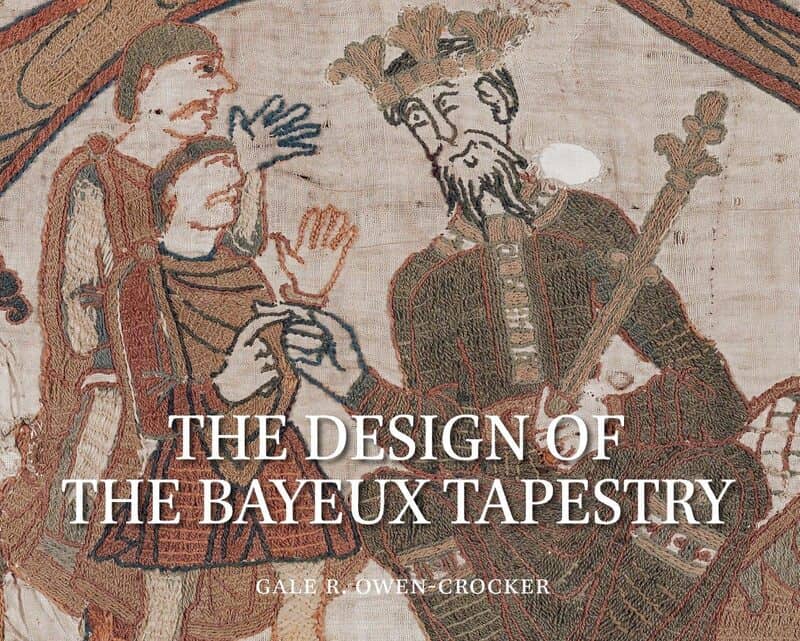
Learn more in this related title from De Gruyter Brill
[Title image: City of Bayeux, DRAC Normandie, University of Caen Normandie, CNRS, Ensicaen, Photos: 2017 – La Fabrique de patrimoines en Normandie]