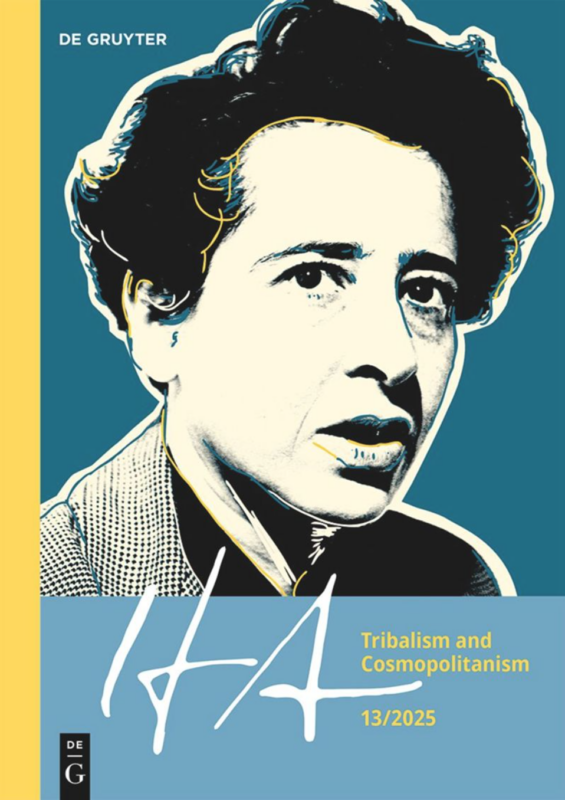
Hannah Arendt in the Twenty-First Century: An Interview With Roger Berkowitz
In times of political instability, readers have repeatedly turned to Hannah Arendt, more often for clarity than for comfort. Her work resurfaces whenever democratic norms begin to erode, insisting on the importance of learning how to think when familiar categories collapse. That task feels newly urgent today.
Few contemporary scholars have done more to sustain this conversation than Roger Berkowitz, founder and Academic Director of the Hannah Arendt Center for Politics and Humanities at Bard College, New York, an international forum for Arendt scholarship and that brings her ideas into direct conversation with the crises of the present.
Tribalism and Cosmopolitanism, published last year in partnership with De Gruyter Brill, takes up one of the defining tensions of our time: the pull between exclusionary identities and the cosmopolitan ideal of a shared world. Inspired by the 2024 Hannah Arendt Center Conference, this volume brings together contributions by prominent thinkers such as Sebastian Junger, Fintan O’Toole, Seyla Benhabib, Niobe Way, Leon Botstein, Lyndsey Stonebridge, and more.
In the interview below, Berkowitz reflects on how Arendt still illuminates political thinking today, helping us to comprehend the dangers of coordination without judgment and the quiet forms of responsibility that endure when public life is under pressure.
Arendt’s “light in dark times”
Serena Pirrotta: In Men in Dark Times, Hannah Arendt writes: “Even in the darkest of times we have the right to expect some illumination, and such illumination may well come less from theories and concepts than from the uncertain, flickering, and often weak light that some men and women, in their lives and their works, will kindle under almost all circumstances and shed over the time span that was given them on earth.”
What kind of illumination or orientation can contemporary readers draw from Arendt’s thinking? And which of her insights do you consider most enduring?
Roger Berkowitz: What jumps off the page from Arendt’s writing is the power of her thinking. Arendt was not a philosopher. She was a political thinker. Thinking means to stop and think, to hold oneself apart from the momentum of the mob and work to bring the wide perspectives of the many into your internal conversation with yourself. She calls this the “enlarged way of thinking” and speaks of a two-in-one, where I speak with myself when I am in solitude.
Thinking brings depth, which is the opposite of superficiality or banality. The danger of the “word-and-thought-defying banality of evil” is that we stop thinking, we cease to be in an imaginative conversation with others who disagree and don’t share our perspectives and prejudices. What is lost then is not intelligence, but judgment – the capacity to tell right from wrong when rules and conventions fail.
“What jumps off the page from Arendt’s writing is the power of her thinking.”
Thinking, Arendt writes, is generally useless and politically sterile. But in times of crisis – when the rest of society is thoughtlessly going along with the crowd – the thinker in his hesitation, in his refusal, appears like a light in dark times: a question mark that says, stop and think! That pause, fragile as it is, can interrupt catastrophe.
Arendt in the Twenty-First Century
SP: If Hannah Arendt were watching today’s world, which issues do you think would most alarm or engage her? And where might she feel compelled to speak out?
RB: Where to begin? The attacks on immigrants, the rise in antisemitism, the blatant corruption of business elites, the arrogance of a bureaucratic elite – all these would terrify but not surprise her. She had already seen how quickly rights collapse when movements mobilize formerly apolitical people in a frenzy of resentment and anger.
But what would most alarm and engage her is, possibly, the cowardice of the intellectuals and leaders who should know better: the retreat from judgment, the preference for moral posturing and job security over political responsibility and courage, and the willingness to exchange thinking for belonging. She would likely be less shocked by demagogues than by the ease with which educated people excuse them.
The Best Way Into Arendt
SP: For someone discovering Arendt for the first time, which book would you put into their hands—and what makes it the right entry point?
RB: The beauty of Arendt is that she writes about so many real-world issues, so it somewhat depends on your interest. If you’re interested in refugees, her essay “We Refugees” and also her magnum opus The Origins of Totalitarianism are essential. If you are worried about post-truth politics, her essays “Lying in Politics” and “Truth and Politics,” along with her speech “Home to Roost,” are great ways into her work.
Her book Between Past and Future offers, as she calls them, eight “exercises in thinking,” and it shows Arendt at her most exploratory and open-ended. And of course Eichmann in Jerusalem, her book about the Holocaust, is where she coins her famous phrase “the word-and-thought-defying banality of evil,” a concept that continues to provoke because it shifts attention from monstrous intentions to everyday failures of judgment.
Her most beautiful book is The Human Condition, but it is not often the easiest way into her work; it rewards slow reading and a willingness to rethink what politics, work, and action mean.
Your Personal Arendt
SP: Which of Arendt’s books means the most to you personally, and what keeps drawing you back to it?
RB: Between Past and Future is the book I could read over and again and would take with me on a desert island. I love its structure of essays that are exercises in thinking – how to think, and thus how to put oneself in conversation with others toward the ideal of building a shared world. The individual essays themselves are profound, provocative, and surprising.
“Arendt turns freedom outward into the political world, so that we are tasked with founding freedom together, in institutions and practices that can endure.”
“Lying in Politics” argues that truth doesn’t fit easily in politics but nevertheless demands that we preserve truth in non-political spaces if politics itself is to survive. “The Conquest of Space” addresses the dangers of scientific thinking detached from human meaning and attunes us to the place of dignity outside technical and instrumental reason.
Her essays “What Is Authority?” and “What Is Freedom?” are among the greatest inquiries into political thinking ever written. We learn that authority has been lost, which seems bad, but that this loss also opens the door for a new beginning grounded in freedom. And freedom, we come to see, has been fundamentally misunderstood as a quality of the will. Arendt turns freedom outward into the political world, so that we are tasked with founding freedom together, in institutions and practices that can endure.
Her essays “The Crisis of Education” and “The Crisis of Culture” push us to rethink education, art, and even politics as practices of care for a shared world. In short, every essay in this book pushes me beyond my comfort zone, forcing me to question my prejudices and to live more attentively, responsibly, and meaningfully with others.
Totalitarianism – Still a Warning?
SP: Arendt’s work on totalitarianism is suddenly everywhere again. How well does her analysis help us make sense of today’s authoritarian drift?
RB: Arendt was convinced of two things. First, it was unlikely that totalitarianism would return in the same forms it took in the mid-twentieth century. In Hitler’s Germany and Stalin’s Soviet Union, total domination and the full denial of freedom were so horrific that it is hard to imagine we would allow them to return in the same forms, with the same openly terroristic ambitions.
“She predicted that the struggle of our time would pit educated technocrats against a non-educated class of workers and citizens who experience the world in less rationalized and less rule-bound ways.”
Second, however, she knew that the “elements” that made the world ready for totalitarianism still remained. The loneliness that prepares people for belonging to mass movements; the antisemitism and racism that dehumanize people and imagine them as the keys to world history; the bourgeois drive for unfettered economic growth unrestrained by moral or political limits; the bureaucratic denial of responsibility and the evisceration of the rule of law. These are not accidental pathologies but modern temptations built into mass society itself.
Because these elements that make totalitarianism seem like a solution to real problems persist, it is likely that it will reappear, though in different and more subtle forms. Arendt worried that the most likely form of future totalitarianism would emerge through the rule of bureaucracy – what she called the “rule of nobody,” where no one appears responsible and yet everyone enforces the system. And she predicted, rightly, that the struggle of our time would pit educated technocrats against a non-educated class of workers and citizens who experience the world in less rationalized and less rule-bound ways. That conflict, she feared, would corrode politics from both sides.
Truth Under Pressure
SP: Arendt warned that politics collapses when shared truths disappear. How do you think she would view today’s landscape of misinformation, social media, and polarized realities?
RB: In many ways the post-truth landscape today is not fundamentally different from what Arendt encountered first in Nazi Germany and later amid the controversy surrounding Eichmann in Jerusalem. Then as now, lies did not succeed because people were ignorant of facts, but because they no longer cared whether something was true or false.
The crucial difference today is the scale and speed of distortion: the power of algorithms and social media to tailor messages that enrage people individually while dissolving any shared sense of reality. What worried Arendt most was not lying as such, but the destruction of a common world in which facts can appear and be contested. Without that shared world, persuasion gives way to manipulation, and politics slides toward coercion or spectacle.
“Then as now, lies did not succeed because people were ignorant of facts, but because they no longer cared whether something was true or false.”
The Individual’s Responsibility
SP: Arendt emphasized the importance of action in the public realm. What role does she assign to individual responsibility, especially in times of crisis?
RB: In many ways, the worry today is less totalitarianism than what Arendt called tyranny. The Greeks coined tyrannos for rulers who seized and wielded power outside constitutional norms. The first tyrant may have been Gyges of Lydia, who murdered the king and married his queen. From Gyges in the seventh century BCE to Julius Caesar crossing the Rubicon, the danger of unaccountable power has long been understood. And yet, as Arendt warned in an interview, “knowledge of the dangers posed by tyranny has never in any way prevented any tyrant from becoming a tyrant.”
Tyranny, Arendt stressed, is not the same as totalitarianism. Under tyranny, there is still social and private freedom, but political freedom is curtailed or eliminated. One can still live well under tyranny, which is precisely why it is so often tolerated.
“What shocked her was not fanaticism, but opportunism.”
The danger of tyranny in America, she feared, was not primarily a single figure like Richard Nixon or Joseph McCarthy – or Donald Trump – but a collapse of faith in republican self-government itself: a willingness to trade freedom and integrity for money, power, and social standing. The deeper threat lay in what she called the “massive intrusion of criminality into the political process,” a normalization of lawbreaking at the highest levels. What worried Arendt most was the phenomenon of coordination – what she elsewhere described as “the eagerness not to miss the train of History.”
During the 1930s in Germany, Arendt was stunned that even before terror was unleashed – before arrests, violence, or camps – many of her friends coordinated with the new regime. They joined the Nazi Party, accepted promotions, and enforced racist and antisemitic laws. What shocked her was not fanaticism, but opportunism.
What is our personal responsibility under tyranny? Arendt addressed this question in a radio talk later published as “Personal Responsibility Under Dictatorship.” She distinguished between two responses to criminal dictatorships and tyrannies.
The first is taken by the “few” who refuse to coordinate or collaborate, withdrawing from public life rather than serve the regime. They avoid being implicated in its crimes, but they also renounce political responsibility.
Further reading: Nicholas Dunn on the origins of Hannah Arendt’s lost Kant lectures and the scholarly impact of their rediscovery.
The second path is followed by those who remain in office, claiming they can “prevent worse things from happening” or “mitigate” harm – the argument of the lesser evil. If faced with two evils, they argue, one must choose the lesser. The danger, Arendt warned, is that “those who choose the lesser evil forget very quickly that they chose evil.” In politics, obedience and support are the same: without them, the tyrant would be powerless.
Those who refuse are often branded “irresponsible,” yet Arendt saw them as the only ones willing to think and judge for themselves. Their refusal was rarely heroic in the conventional sense; they did not necessarily risk their lives or lead resistance movements. They simply could not stomach doing what the regime required. They refused to rationalize cruelty or injustice as necessary. Their consciences did not run on automatic, nor did they outsource judgment to prevailing opinion. They resigned, withdrew, and went into what she called “internal migration” – a quiet form of integrity that preserves the possibility of responsibility when politics itself collapses.