26 Years a Slave: Juan Miranda’s Fight for Freedom in Colonial New York
The 1735 trial of printer John Peter Zenger is remembered as a foundational moment in the history of press freedom in colonial New York. Far less known is the case of Juan Miranda, the first enslaved man to take his enslaver to the colony’s Supreme Court to fight for his own freedom.
26 Years a Slave: Juan Miranda and Other “Spanish Negroes” in Colonial New York (De Gruyter Brill, 2025) tells the story of Juan Miranda, a man from Cartagena in present-day Colombia who, after being seized as a youngster from a ship in waters off what is today Venezuela and taken prisoner to the Dutch island of Curaçao, arrived in New York in 1734 aboard the vessel of the English captain William Axon. Juan had believed false promises, and once in the city, Axon and a merchant cajoled him into entering an alleged indentured-servant contract with Pieter van Ranst, a sailmaker. Miranda was ultimately enslaved by this family of Dutch descent.
Pieter van Ranst died early in 1741, without returning Juan to freedom. That same year, colonial authorities ensnared Miranda in the so-called New York Slave Conspiracy, but the young Afro-Cartagenero managed to survive. Once released from prison and returned to Sarah van Ranst and her son Cornelius, Juan appeared to enter a phase of quiet resignation, waiting for a more propitious and less dangerous moment to claim his freedom.
“New York enslavers routinely captured and sold Spanish-speaking Afro-descendant, Indigenous, and mixed-race mariners.”
This moment came after November 1752, with the arrival from London of William Kempe as attorney general of the Province of New York. Upon assuming office, Kempe was asked to deal with a letter that Melchor de Navarrete, governor of St. Augustine, had sent to the governor of New York earlier that year, advocating for the freedom of forty-five mariners seized at the end of King George’s War and kept in bondage in New York.
New York enslavers routinely captured and sold Spanish-speaking Afro-descendant, Indigenous, and mixed-race mariners. Spanish officials intervened only rarely to rescue them. By happenstance, however, Navarrete’s claim and the arrival of an English authority with a very different perspective on the enslavement of free-born men converged in New York. News that Kempe believed in the free status of the so-called Spanish Negroes and presented their cases to New York’s highest authorities as free subjects of the king of Spain – regardless of their skin color – spread quickly. Clandestinely, Caribbean sailors began to ask Kempe to submit their petitions for freedom before the governor and his council.
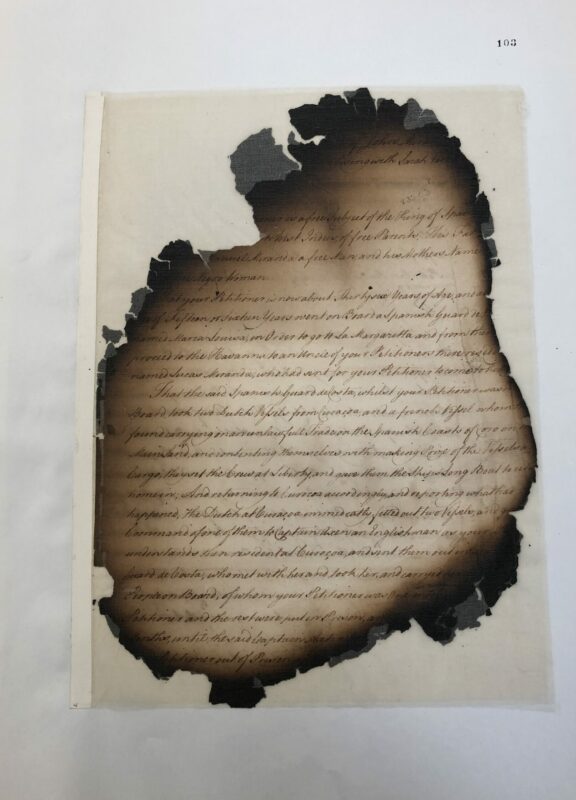
A limited number of young men, enslaved in the city rather than on rural estates where such opportunities were out of reach, came forward to tell their stories to the attorney general. They recounted their capture by English privateers while serving aboard Spanish privateers or naval ships; at other times, English privateers engaged in coastal foraging and maritime predation against smaller or fishing vessels kidnapped them, brought them to the city, and sold them. In some cases, their sale followed a ruling by the Vice-Admiralty Court of New York condemning them as slaves; in others, powerful privateers and merchants illegally inserted them into the colony and sold them fraudulently. Such was the fate of Manuel de Cumaná, an Indigenous man from the Venezuelan territory who had been sent to Orange County and managed to flee from Abraham Paulding to seek Kempe’s help. Taken together, their cases illuminate not only the machinery of Atlantic slavery but also the forgotten service performed by marginalized men in the imperial wars of the Caribbean.
“Their cases illuminate not only the machinery of Atlantic slavery but also the forgotten service performed by marginalized men in the imperial wars of the Caribbean.”
The book pieces together Juan Miranda’s story through archival research, revealing what is now the best-documented case of a Spanish Afro-Caribbean man enslaved in New York. It brings into view a prolonged legal struggle that began in the summer of 1755, after William Kempe filed Miranda’s petition for release. By that point, the Van Ranst family had kept Juan enslaved for twenty-one years. The struggle lasted until about 1760. During this period, Miranda’s insistence on his status as free vassal of Spain provoked retaliatory punishments by the Van Ransts, who beat him, confined him in the Workhouse, and attempted to resell him in order to remove him from the city or even the colony and place him beyond the reach of his advocate. The strategies employed by the Van Ransts, their lawyer, and other collaborators to keep Juan enslaved reveal the social and legal networks that contested his claims and help explain why legal efforts to liberate such men so rarely succeeded.
Most likely, Miranda did not achieve the outcome that contemporary readers might wish for him. Yet the efforts of his son, John Moranda, to improve African Americans’ lives in New York during the first three decades of the nineteenth century – after purchasing his own freedom in 1795 – allow us to see the enduring repercussions of Miranda’s hard life in the city.
[Title Image by William Cullen Bryant. Colonial New Amsterdam, Manhattan in 1790, which became New York City, New York, USA. Copyright is in public domain. Via Getty Images/Christine Kohler]