Written Out, Written Over: Women* in Church History
For centuries, church history has been told as if only a few voices mattered — and most of them were male. Countless women*’s lives and contributions remain hidden in archives, reduced to footnotes, or overwritten by later interpretations that say more about their interpreters than about them. What happens when we begin to read this history differently and ask not only who is remembered, but who has been made invisible?
Editor‘s note: The asterisk after “women” signals that the author includes not only cis-women under this term but also transgender women, non-binary people, and others who may relate to the broader umbrella of womanhood.
“Dusty, Erased, Forgotten …”: behind this triad, that gave name to a conference and an edited volume I published with a colleague of mine, lies not just (womens’) “history” (in its deceptively singular form), but a wealth of real, often overlooked and sometimes deeply tragic stories. These are frequently the stories of women* and marginalized groups: stories that gather dust in archives, are pushed aside by supposedly more “important” narratives, or simply fall through the cracks of historiography. And yet, they are precisely the stories worth telling, even after several decades of feminist church historiography.
Because even today, many of these narratives sit at the margins of what is considered the “canon” of church history — rarely counted among its core knowledge and often seemingly excluded from the so called academic mainstream. This is despite the fact that women* have always played active roles in shaping Christianity: as writers, as transmitters of faith, and as practitioners of lived discipleship (imitatio Christi).
“Women* have always played active roles in shaping Christianity: as writers, as transmitters of faith, and as practitioners of lived discipleship.”
Especially at times like Women’s History Month, it’s important to remember: Feminist scholarship began pushing back against this erasure decades ago. Since the 1970s, feminist theologians have spoken of a “rediscovery” of women’s history. This period, often referred to as the “second wave” of feminist research, focused on one key goal: making women* visible and exposing the blind spots of a field long dominated by male perspectives. Concepts like Elisabeth Schüssler Fiorenza’s “hermeneutics of suspicion” — the idea that biblical texts are shaped by patriarchal assumptions and need critical re-reading — became foundational for this work. And while much has been achieved, the task is far from complete. Making historical women* visible remains an ongoing challenge, a necessary step toward telling a fuller, more inclusive story of the past.
Katharina von Bora – More Than the “Pastor’s Wife”
But things aren’t always that simple: often, it’s precisely these sources from women* that haven’t been passed down, as the memoria of female actors seemed too insignificant, and too little value was attached to their sources. When it comes to the Reformation period, Katharina von Bora is an interesting example: As with many women* from this period, we have only a few sources about her – but if we think of Elisabeth Cruciger (1500–1535), for example, at least her hymn can still be found in hymnals, or Argula von Grumbach (1492–1554), whose decisive letters in her dispute with the Innsbruck faculty have been preserved.
“Across the centuries, Katharina von Bora’s image shifted with changing agendas.”
Katharina von Bora (1499–1552) is usually remembered as the wife of Martin Luther (1483–1546), yet her story reveals how women* in church history are not simply remembered, but continually reshaped. A former nun who left her convent during the Reformation and married Luther in 1525, she quickly became a symbolic figure. In Roman Catholic polemics, she appeared as a scandal or a seductress; in Protestant narratives, she was elevated as a model wife. In both cases, she was less an individual than a projection.
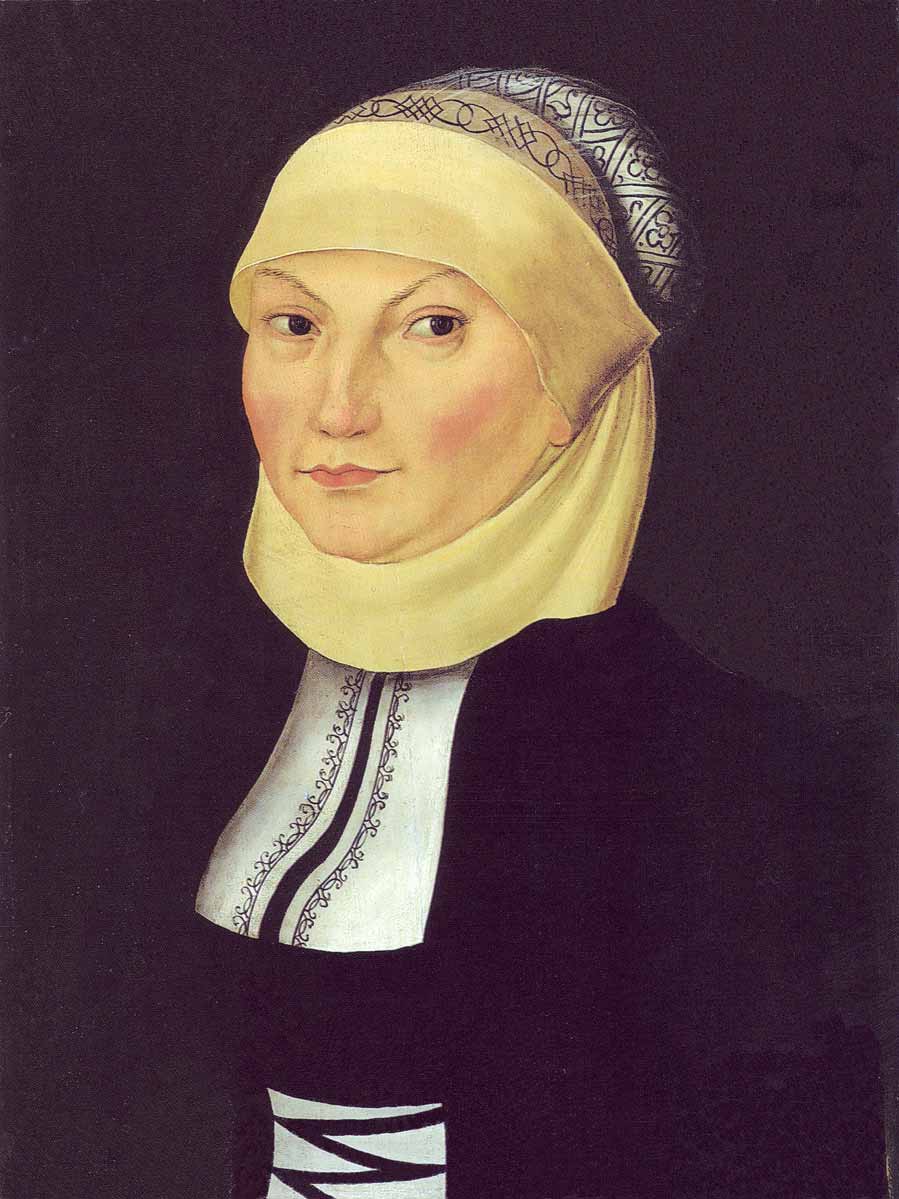
Across the centuries, her image shifted with changing agendas. Early modern controversies turned her into a weapon in confessional debates. The 19th century reinvented her as the ideal Protestant “pastor’s wife”— a role that reflects bourgeois gender norms far more than the realities of the 16th century. Modern scholarship has begun to recover a more complex picture: Katharina as an economically capable household manager and an active participant in her social world. Yet because so few sources from her own hand survive, her voice remains faint. Katharina von Bora thus stands as a reminder that women* in church history are often not only written out but also written over.
Feminism(s) Beyond Women’s History
Since the 2000s, the conversation has expanded. Gender history has joined women’s history, and “gender” itself has emerged as a key analytical concept. Instead of focusing only on individual women — and at this point, as a slight criticism, deliberately without an asterisk —, scholars now also examine broader questions: how femininities and masculinities are constructed, how institutions like marriage and family are shaped by gender, and how power operates through these structures.
“Today, women’s and gender research in Church History should best understood as a multi-generational feminist project.”
This shift didn’t replace women’s history, it deepened it. Researchers began questioning fixed ideas of gender, drawing on concepts like “doing gender” and engaging with thinkers such as Judith Butler. The result? A more critical approach that challenges the idea of gender as “natural,” deconstructs binary thinking, and opens the door to queer perspectives on religion. Church history, like the wider historical field, underwent a fundamental methodological rethink — or is at least in the middle of it.
Today, women’s and gender research in Church History should best understood as a multi-generational feminist project. It brings marginalized perspectives into focus, enriches familiar topics with new insights, and creates space for dialogue across generations. This exchange is key: it prevents knowledge from being lost, connects different scholarly traditions, and embraces the diversity of academic experiences to build more nuanced, interconnected understandings.
What unites all feminist research in Church History, however, is a shared commitment: to challenge the processes of forgetting, marginalization, and exclusion that have shaped church history for so long. In the end, this is not just about filling gaps in the historical record. It’s about rethinking how we tell history altogether — whose voices we include, whose we overlook, and how we can do better.
Learn more in this related German-language title from V&R/De Gruyter Brill
[Title image: Painting by Lucas Cranach the Elder (1472–1553) via Wikimedia Commons]