The Past and Present of Fascist Internationalism
The growing networking and cooperation among far-right parties and heads of government points to the emergence of a new “Nationalist International” in the 21st century. Similar cooperation between fascist movements and regimes can be seen as early as the first half of the 20th century, characterized by a contradiction between ultranationalism and internationalism. What parallels can we draw from this, and what can we learn?
An earlier version of this text has been published in German in the journal Wissenschaft & Frieden, 2025/4: Autoritäre Wende: Repression – Militarisierung – Faschisierung.
The appointment of Abelardo de la Espriella as the new president of Colombia in the summer of 2026 is just one more example of the growing global trend of far-right leaders rising to power, a trend that is also evident in Europe, where far-right parties such as the Alternative für Deutschland (AfD) and the French Rassemblement National (RN) are gaining ground. Furthermore, de La Espriella’s endorsement by Trump during the Colombian presidential elections, coupled with his imitation of Trump’s style, illustrates how these far-right figures support each other while learning from their rhetoric, themes, and strategies (Lewandowsky, 2025; Meiritz & Schäuble, 2025; Greven, 2026).
This new “Nationalist International” is driven by shared goals, such as the restoration of alleged national sovereignty, the destruction of liberal democracy, and the end of the so-called rules-based international order tied to international law and the United Nations, in place of which the law of the strongest appears to be taking hold once more.
Against this backdrop, warnings of a resurgence of fascism are growing, as seen in “A Century Later: A Renewed Open Letter Against the Return of Fascism”, published in June 2025 and signed by leading researchers on fascism and far-right extremism such as Timothy Snyder, Cas Mudde, and Ruth Wodak. The open letter denounces “a renewed wave of far-right movements, often bearing unmistakably fascist traits: attacks on democratic norms and institutions, a reinvigorated nationalism laced with racist rhetoric, authoritarian impulses, and systematic assaults on the rights of those who do not fit a manufactured traditional authority, rooted in religious, sexual and gender normativity.”
In a similar vein, one could argue that the current international networking of far-right actors constitutes a reverberation of a historical phenomenon for which historians have coined the term “fascist internationalism” (Ledeen, 1972; Herren, 2016; Hamre, 2025). However, the aim of this text is not to claim that the European fascist internationalism of the 1930s has simply returned, as this would ignore the substantial political, economic, and cultural differences between the twentieth and twentieth-first centuries, which have irrevocably changed the nature of politics in an era of a digital revolution and social media. Rather, the objective is to reflect on the parallels between the past and present, based on the insights from the book “Fascists of the World, Unite? A History of Fascist Internationalism in the 1930s”.
The Contradictions of Fascist Internationalism
As an umbrella term, fascist internationalism encompasses the exchange of ideas, networking processes, and forms of cooperation among ultranationalist actors, organizations, and regimes from various countries. Yet such internationalism is marked by a contradiction.
On the one hand, fascism emphasizes the “natural” inequality between peoples and “races” and strives for the mythical rebirth of its own, supposedly homogeneous nation (Griffin, 2018). The notion of the superiority of one’s own people legitimizes expansionism and imperialism. Due to racism and xenophobia, fascism assumes that its own nation degenerates because of the intrusion of “foreign” influences into the national “community of the people.” Thus, within fascism’s conspiracy-laden, populist, and partly anti-capitalist worldview, international “elites” and in particular “international Jewry,” which allegedly seeks to destroy national identities and cultures, become the ultimate enemy.
On the other hand, despite its rhetorical rejection of internationalism, fascism seeks cooperation with foreign partners—both for strategic reasons and out of ideological kinship—to combat common enemies such as liberal democracy and communism.
The Fascist International of the 1930s
After its rapid rise to power, Italian fascism, founded by Benito Mussolini after the First World War, became an international model as early as the 1920s. Movements emerged across Europe that either identified as fascist or emulated the Italian model rhetorically, stylistically, and ideologically, even though they pursued a national agenda.
Parties such as Adolf Hitler’s NSDAP copied the Roman salute as well as anticommunism, anti-parliamentarianism, the glorification of violence and youth, and the cult of the leader centered on Mussolini. Meanwhile, the Great Depression of 1929 facilitated the rise of fascism as a pan-European phenomenon. Mass unemployment and economic recession called into question the credibility of capitalism, parliamentary democracy, and the international order in many places, which not only facilitated the NSDAP’s rise to power in Germany but also led to the founding of further fascist parties and the emergence of authoritarian dictatorships in Portugal, Austria, and Spain, which borrowed ideological, structural, and aesthetic elements from Fascist Italy.
“The 1930s became the first heyday of fascist internationalism, during which fascists deliberately built transnational networks through umbrella organizations, conferences, party conventions, and correspondence.”
Thus, the 1930s became the first heyday of fascist internationalism, during which fascists deliberately built transnational networks through umbrella organizations, conferences, party conventions, and correspondence. A decisive factor in this was the increasingly international orientation of Italian fascism. After the regime had consolidated its power, Italian intellectuals developed in the late 1920s the thesis that fascism was “universal” and a model for the world while promoting the Mussolini regime’s claim to global leadership. Consequently, Italy founded an international networking agency named the Action Committee for the Universality of Rome (Comitati d’Azione per l’Universalità di Roma, CAUR) in 1933. Modeled after the Communist International led by the Soviet Union, CAUR sought to unite ultranationalist movements throughout Europe under Italian leadership.
To this end, a Fascist International was to be established at a conference in Montreux, Switzerland. In December 1934, more than a dozen European movements gathered and drafted the Montreux Resolution, which extolled the “universality of fascism” as a solution to the world’s political, economic, and intellectual crises and demonized liberalism, socialism, communism, and internationalism.
However, the Montreux Conference also revealed significant differences within the supposedly unified fascist camp. The issue of antisemitism divided the participating parties, as did Italy’s claim to leadership, which was questioned by participating parties from Northern Europe who were convinced of the superiority of the “Nordic-Aryan race.” Significantly, no representatives of German National Socialism had been invited, as Mussolini still regarded Hitler as a rival at that time.
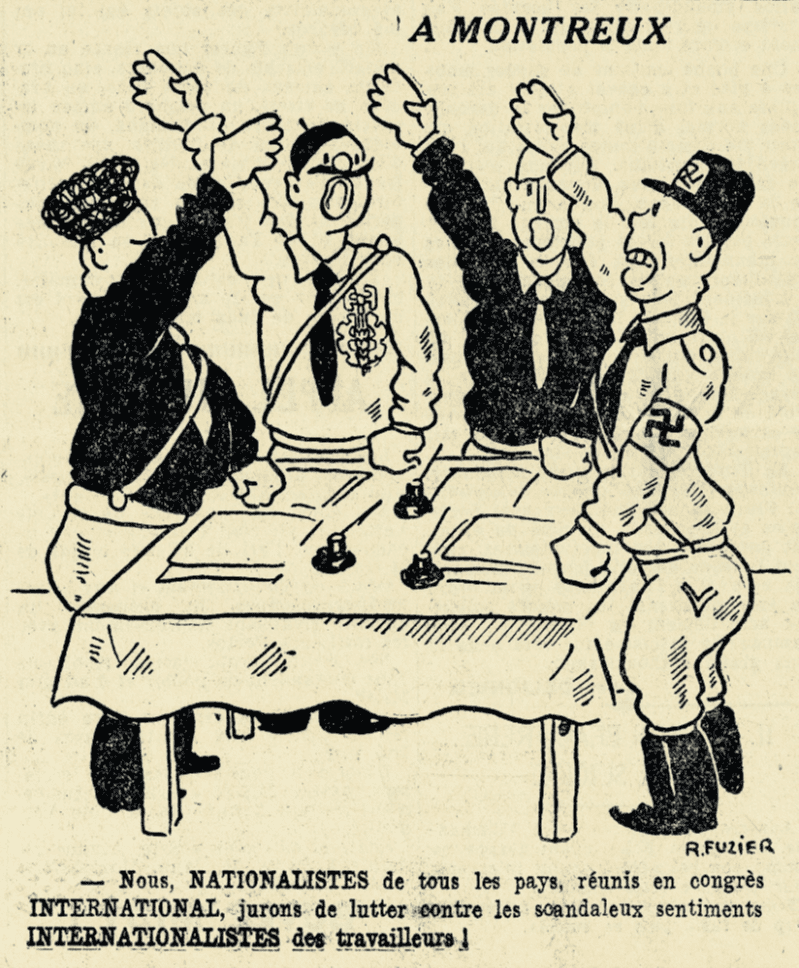
As a result of this Italo-German dispute, a counter-organization called the International Working Group of Nationalists (Internationale Arbeitsgemeinschaft der Nationalisten, IAdN) was formed in the German Reich. This self-proclaimed Nationalist International brought together at conferences almost exclusively male figures from academia and politics, whose common ground was völkisch nationalism, racism, antisemitism, and anticommunism, while denying the expansionism of the Third Reich. Parallel to this, the Welt-Dienst news agency in Erfurt developed into the linchpin of an “Antisemitic International,” whose anti-Jewish congresses were frequented by leaders of various small fascist parties.
From Propaganda to the Battlefield
The collaboration between fascist regimes and smaller movements was characterized, in political and economic terms, by an asymmetrical relationship of dependency, in which Italy and Germany used parties in other countries as multipliers and mouthpieces for their ideology and policies. Italy, for example, covertly financed a Swiss Fascist Movement to legitimize its imperialist attack on Abyssinia in the fall of 1935 through propaganda abroad. But even smaller parties such as the Danish DNSAP benefited from this cooperation by presenting themselves in the media, with the propagandistic help of their allies, as part of an international fascist zeitgeist that would now inexorably conquer other countries as well, such as Denmark.
Fascist internationalism in the 1930s was not limited to networking meetings, financial support, and media propaganda. During the Spanish Civil War (1936–1939), it also fought its enemies on the battlefield. After a coup by Spanish nationalist forces against the democratically elected government in the summer of 1936, it was not only Italy, Germany, and the Portuguese Salazar dictatorship that supported the anti-democratic uprising led by Francisco Franco; in response to the International Brigades of the Communist International, fascists from abroad also went to war on Franco’s side. The largest group was 700 Irish volunteers known as the “Irish Brigade” led by the fascist leader Eoin O’Duffy who tried to fight “godless communism” in a “crusade” abroad before the supposed threat would take over at home. The Spanish Civil War also fostered a rapprochement between Mussolini and Hitler, who officially became allies in the fall of 1936.
“Fascist internationalism in the 1930s was not limited to networking meetings, financial support, and media propaganda … it also fought its enemies on the battlefield.”
From that point on, fascist internationalism was characterized by political alliances between governments that cooperated with one another economically, culturally, and militarily. The Anti-Comintern Pact (1936), an international treaty between the German Reich and the Empire of Japan, which Italy later joined, and which emphasized in its propaganda the joint struggle against the Soviet Union, gave rise to the global “Rome-Berlin-Tokyo Axis” (Hedinger, 2021). Through the Tripartite Pact of 1940, the three regimes formally cemented their military cooperation, which they used to pursue their respective national, expansionist, and genocidal goals during the Second World War
Developments During and After the Second World War
The period between 1939 and 1945 fundamentally altered fascist internationalism, as large parts of Europe were occupied by the Axis powers. While the German Reich, Italy, and Japan initially cooperated as equals, smaller movements were reduced to the asymmetrical role of so-called “fifth columns” in neutral countries or collaborators in occupied territories. This also opened up the possibility for some fascist parties—such as the Norwegian Nasjonal Samling under Vidkun Quisling and the Croatian Ustaše under Ante Pavelić—to exercise executive power for the first time as puppet governments. This collaboration was legitimized by shared enemy stereotypes such as “Jewish Bolshevism” and the idea of establishing a völkisch-nationalist “New Europe” under the leadership of the “Greater Germanic Reich.”
Despite the military defeat of the Axis powers at the end of the Second World War, fascist actors continued to network in the postwar period by jointly publishing magazines such as Nation Europa, organizing congresses such as one in Malmö in 1951, and forming new umbrella organizations, such as the European Social Movement (Europäische Soziale Bewegung, ESB). This networking was by no means limited to Europe, as underscored by the World Union of National Socialists (WUNS), founded in 1959, which linked neo-Nazi groups worldwide—from the United States to Scandinavia.
Parallels Between Past and Present
The following parallels can be drawn between historical fascist internationalism and contemporary forms of far-right internationalism.
“Just as fascist movements and regimes of the interwar period copied tactics and ideas from one another, groups from today’s global far right also draw inspiration from one another.”
First, just as fascist movements and regimes of the interwar period copied tactics and ideas from one another, groups from today’s global far right also draw inspiration from one another. Their learning process includes methods such as stoking distrust in mainstream media through “fake news” and spreading conspiracy narratives about the “Great Replacement” of the white, Christian population by Muslim immigrants, whose supposedly targeted “mass immigration” is intended to erase national identities and ultimately even nation-states.
In the process, political opponents are defamed using codes and ciphers such as “globalists.” Analogous to the antisemitic conspiracy narratives of historical fascism, this refers to unpatriotic “international elites” who are allegedly planning a global upheaval, the “Great Reset.” For far-right heads of government such as Javier Milei and Donald Trump, this Authoritarian Learning (Heydemann, 2024) also involves political strategies such as strengthening executive power, weakening the legislature, attacking civil society and opposition parties, bolstering security forces, and controlling the media.
This mirrors the measures taken by fascist leaders from Mussolini to Franco, who drew inspiration from one another as they transformed their respective democratic systems into one-party dictatorships. Analogies to the past also exist with regard to the asymmetrical relationships between authoritarian regimes and far-right parties, some of which are covertly supported and financed. For example, the Putin regime uses European partners such as the AfD as a mouthpiece for Russian interests in the fight against the EU and its sanctions.
Second, much like the Fascist International of the 1930s, the far right has created a network through transnational umbrella organizations, think tanks, and conferences. The Conservative Political Action Conference (CPAC) is a prime example of this, having evolved from an annual U.S. event in the 1970s into a driving force in the consolidation of a tightly knit network of reactionary movements, political parties, and publishing platforms around the world. CPAC now also hosts conferences in Buenos Aires and Budapest, attracting “the International of Nationalists like honey attracts wasps” (Lehming, 2023). Trump’s former chief advisor Steve Bannon plays a prominent role as a networker in this context; for years, he has been attempting to unite the European far right under the contradictory slogan “Nationalism first.”
“Ultranationalist actors actively contribute to the teleological narrative of presenting a globally homogeneous unit that is on an unstoppable path to success in the fight against common enemies such as Islam, ‘mass immigration,’ and ‘wokism.’”
Third, the current global far right is also shaped by the tension between ultranationalism and internationalism. This is illustrated by the far-right faction in the European Parliament, Patriots for Europe (PfE), which, at a meeting in February 2025, adopted the slogan “Make Europe Great Again”—copying the slogan of the ultranationalist U.S. movement “Make America Great Again” (MAGA) (Meiritz & Schäuble, 2025). Like their historical predecessors, far-right parties and regimes present themselves as allies and “comrade-in-arms in the battle for good, for truth, common sense and freedom,” as Santiago Abascal of Spain’s Vox party proclaimed at the PfE summit. There, delegates welcomed Trump’s reelection “as a harbinger of future victories for their camp” (Morel & Kaval, 2025).
Through such references to the rise of their international allies, ultranationalist actors actively contribute to the teleological narrative of presenting a globally homogeneous unit that is on an unstoppable path to success in the fight against common enemies such as Islam, “mass immigration,” and “wokism.” This resembles the propaganda of “universal fascism” from the previous century.
However, in contrast to this supposed homogeneity, the global right consists of a broad spectrum of populist, radical, and far-right actors and organizations, meaning that ideological differences, territorial disputes, and political rivalries shape their fragile attempts to unite across borders. This fragmentation was clearly evident, for example, in the aftermath of the June 2024 European elections, when three competing factions were formed: Patriots for Europe, the European Conservatives and Reformists (ECR), and the Europe of Sovereign Nations (ESN).
Critical scholars should thus deconstruct the myth of a homogeneous front of nationalist forces to develop counter-narratives to the supposedly unstoppable rise of the far right. For instance, the far-right narrative stands in contrast to the surprising election defeat of Viktor Orbán in April 2026 in Hungary, who, with his form of “illiberal democracy,” had been one of the leading figures of the Nationalist International up to that point. Orbán lost even though numerous far-right allies—from Benjamin Netanyahu to Marine Le Pen—had endorsed him in a video on the platform X during the election campaign.
“Critical scholars should deconstruct the myth of a homogeneous front of nationalist forces to develop counter-narratives to the supposedly unstoppable rise of the far right.”
To conclude, as in the past, ultranationalists will continue to exploit the mechanisms of internationalism to build networks of allied forces and spread their dangerous ideologies worldwide, thereby threatening pluralistic democracies, the rule of law, and marginalized groups. For scholars committed to peace, the history of the Second World War in particular teaches that global alliances between far-right regimes, ideologically grounded in racism, white supremacy, and notions of national superiority, by no means protect against further escalation but can instead pave the way for expansionism, war, and genocide.
Learn more in this related title from De Gruyter Brill
You might also be interested in this recorded conversation with our authors, Martin Hamre and Christian Jacobs:
You are currently viewing a placeholder content from YouTube. To access the actual content, click the button below. Please note that doing so will share data with third-party providers.
[Title Image by Solen Feyissa via Unsplash]