Silent Night, Political Night: Christmas Films in Cold War America
Christmas films like to pretend they’re harmless seasonal comfort, but history suggests otherwise. A new book examines how postwar American cinema used Christmas to negotiate politics, patriotism, and conformity under the pressures of McCarthyism.
Everything is better at Christmas. Or, at least that’s what Hollywood would have you believe in the second half of the 20th century.
Like every complicated reality of the American experiment, Christmas is a deeply diverse representation of the best, worst, and banal in American history, and studying it can help us better understand ourselves and our world. By examining the holiday within its appropriate historical context and considering each iteration’s place in the vast history of Christmas studies, we can analyze the holiday at any point in American history for what it says about who we are as a nation, what values we hold, and how we would like to be remembered.
“Christmas is a deeply diverse representation of the best, worst, and banal in American history.”
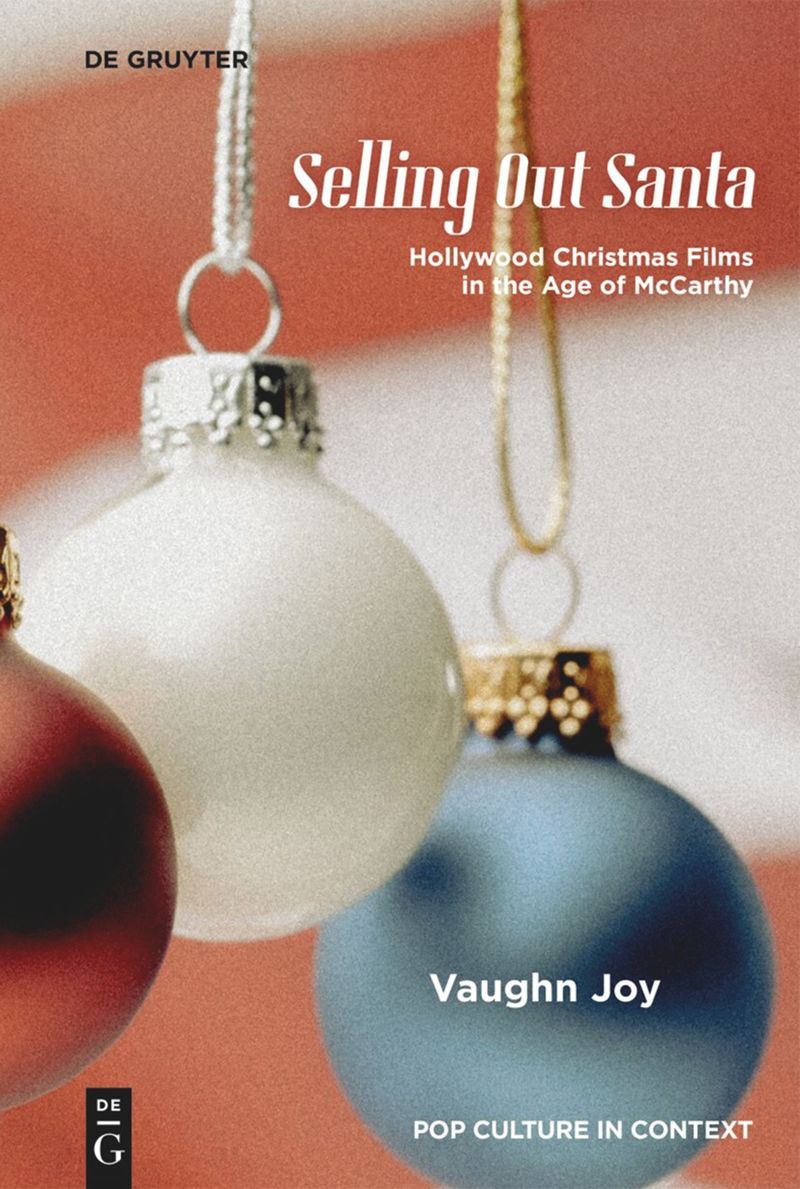
In my new book, Selling Out Santa: Hollywood Christmas Films in the Age of McCarthy, I use this framework of the American Christmas as a temporal societal mirror to analyze cinematic depictions of the holiday in the post-war, early Cold War period. The book takes into account histories of Christmas from the 19th and early 20th centuries while also exploring the period contemporary to the films, 1946 to 1961, to understand how and why the Christmas holiday was invoked in Hollywood releases throughout this tumultuous time in American politics and culture and, crucially, how it changed as a result of such fractured times.
It’s Beginning to Look a Lot Like Mainstream Interpretations of Christmas
In the late 1940s, Hollywood became embroiled in scandal with allegations that some films were peddling Communist subversion. Throughout World War II, Hollywood had been a very prominent and prolific peddler of pro-American propaganda for the war effort. But, once the war ended and the power of such a vast cultural machine was realized, some in the government feared the possibility of such a machine in the wrong hands.
Others, such as the Chairman of the House Committee on Un-American Activities (HUAC), J. Parnell Thomas, floated the idea with screenwriter and producer James K. McGuinness that perhaps Hollywood should continue making overtly pro-American media for cultural and civic instruction. While that propagandistic dream did not come wholly true for Thomas and McGuinness, we can read cultural shifts in this period that echo a new political reality in 1950s America.
“We quickly got films with simpler plots, simpler problems, and simpler portrayals of Christmas.”
Investigated by the FBI, interrogated by HUAC, and imprisoned by the Hollywood Blacklist, the motion picture industry was under immense pressure in the mid-century to avoid federal suspicions of Communist sympathies. Not every film released in this period conformed to these pressures, some even outrightly challenged the pressure to conform, but the Christmas films in this period did change drastically. This change can be oversimplified as shifting in tone and content from communal attitudes of the holiday to staunch individualism.
Christmas films from 1946 and 1947, including It’s a Wonderful Life, Miracle on 34th Street, and The Bishop’s Wife, all have some degree of communalist musing on society. Whether through Dickensian tradition or Santa mythology, these films emphasize the importance of community, empathy, and fighting against our worst, most selfish impulses purely for financial profit.
Once HUAC began their hearings in October 1947 and the Hollywood Blacklist was enacted in November, however, these communalist ideas faded away. We quickly got films with simpler plots, simpler problems, and simpler portrayals of Christmas.
Films including Holiday Affair (1949), Susan Slept Here (1954), and White Christmas (1954) all work to establish the Christmas rom-com formula that Hallmark Channel uses so well to this day, culminating in a heternormative marriage and an insinuation that the women will leave the workplace. In a genre in which the prevailing storylines were previously about ways to address poverty, homelessness, and crises of faith on a national scale, these films from the 1950s mark a considerable change when the worst thing that can happen is that Janet Leigh doesn’t choose Robert Mitchum over Wendell Corey in Holiday Affair.
“In times as fractured as these, media literacy is a survival skill.”
This analysis may seem trivial, but only because we allow our public imagination to trivialize some media. We often do not think of Christmas films as purveyors of social and political commentaries that can color our contemporary or historical perceptions, but that is largely because they have become a form of innocuous media in our public discourse. In my research I take it as a given that no media or art is apolitical, and that all media and art deserves to be scrutinized.
In times as fractured as these, times that certainly try men’s souls, media literacy is a survival skill. Whether it is the ability to identify AI images and writing, understand insinuations in advertisements, or interrogate seemingly innocuous films and television, it is essential to practice our analytical skills with all types of media.
Selling Out Santa encourages us all to think more deeply about the cultural media we are consuming, put it into its appropriate historical, political, social and economic contexts, and be open to understanding what messages are present and what they might mean for us as the audience. It says, ‘please do keep enjoying your favorites while also growing your ability to discern propaganda when you see it, because these times demand that of you.’
Learn more in this related title from De Gruyter
[Title Image by Clu/DigitalVision Vectors/Getty Images]